






Earthquakes are among the most powerful natural events on Earth, releasing enormous amounts of energy that travel through our planet as seismic waves. In GCSE AQA Physics, understanding P waves and S waves is essential for explaining how earthquakes occur, how scientists study Earth's interior, and how seismic data helps save lives.
Although these two types of seismic waves are both produced during an earthquake, they behave very differently. Knowing their properties and being able to compare them is a common GCSE examination requirement.
When rocks suddenly break or slip along a fault line, large amounts of energy are released. This energy travels through the Earth as seismic waves.
Scientists detect these waves using sensitive instruments called seismometers, which record the vibrations produced by earthquakes.
The two main types of body waves studied at GCSE are:
Their different speeds and behaviour help scientists investigate the Earth's internal structure.
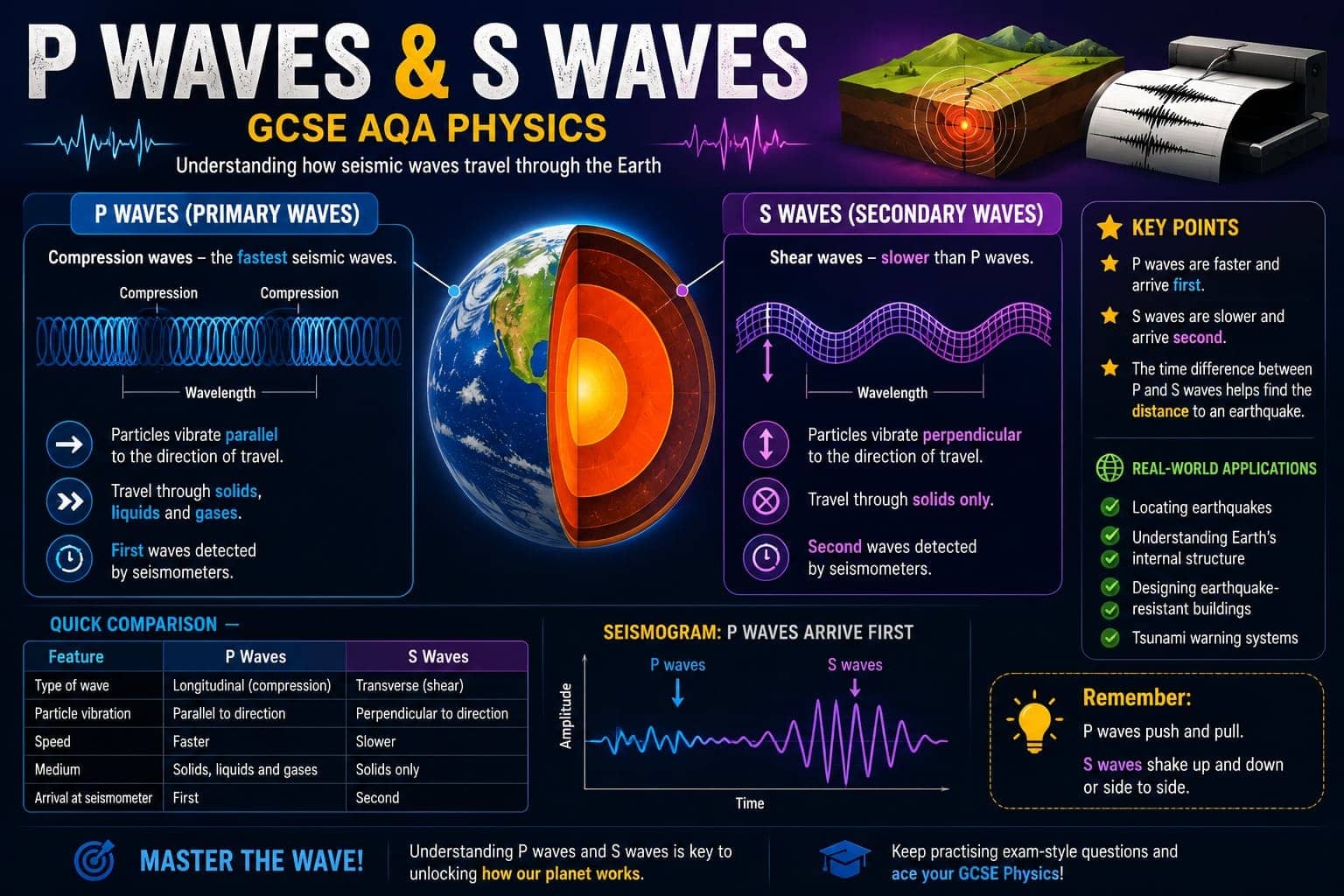
P waves (Primary Waves) are the fastest seismic waves, meaning they are always the first to arrive at a monitoring station after an earthquake.
P waves are longitudinal waves, where particles vibrate parallel to the direction of wave travel. As they move, they repeatedly compress and expand the material they pass through.
Because P waves can move through liquids, they are able to travel through the Earth's liquid outer core.
S waves (Secondary Waves) travel more slowly than P waves and therefore arrive later.
Unlike P waves, S waves are transverse waves, where particles vibrate perpendicular to the direction of travel.
Since liquids cannot support shear forces, S waves cannot travel through the Earth's liquid outer core.
Understanding the differences between these two wave types is a key GCSE skill.
| Feature | P Waves | S Waves |
|---|---|---|
| Wave Type | Longitudinal | Transverse |
| Speed | Faster | Slower |
| Particle Motion | Parallel to travel | Perpendicular to travel |
| Travels Through | Solids, liquids and gases | Solids only |
| Arrival Time | First | Second |
A useful way to remember this is:
Seismic waves provide valuable information about the Earth's internal structure.
Scientists discovered that:
These observations provide strong evidence that the Earth consists of several layers:
Without seismic waves, we would know very little about what lies beneath our feet.
A seismogram is the record produced by a seismometer.
Because P waves arrive before S waves, scientists can measure the time difference between their arrivals.
The larger the time gap:
By comparing recordings from several monitoring stations, scientists can accurately locate an earthquake's epicentre.
Understanding seismic waves has many practical applications.
Scientists use them to:
Their work helps reduce the impact of natural disasters and improves public safety worldwide.
Students should be able to:
Practising comparison questions and labelled diagrams is an excellent way to prepare for GCSE examinations.
At Mathsalpha Academy, we help students build confidence through clear explanations, engaging lessons, and exam-focused practice. Complex topics such as seismic waves become easy to understand with expert guidance and structured revision.
Whether you're preparing for your GCSE exams or strengthening your understanding of Earth and Space Physics, our experienced tutors are here to help you achieve your best results.
Start mastering GCSE Physics today and turn challenging topics into your strongest subjects.
Join our GCSE and A-Level Physics tutoring programmes and discover how expert guidance can help you achieve outstanding examination results.
Book Your Free Assessment
.png)
.png)
.png)
.png)

.png)
.png)
.png)
.png)



.png)
.png)
1.png)


.jpeg)




See our Trustpilot Excellent Reviews