








.png)
Understanding data is an important part of mathematics. Whether you are looking at exam scores, sports statistics, weather reports, or business data, you often need a way to summarise a group of numbers. This is where Mean, Median, and Mode come in.
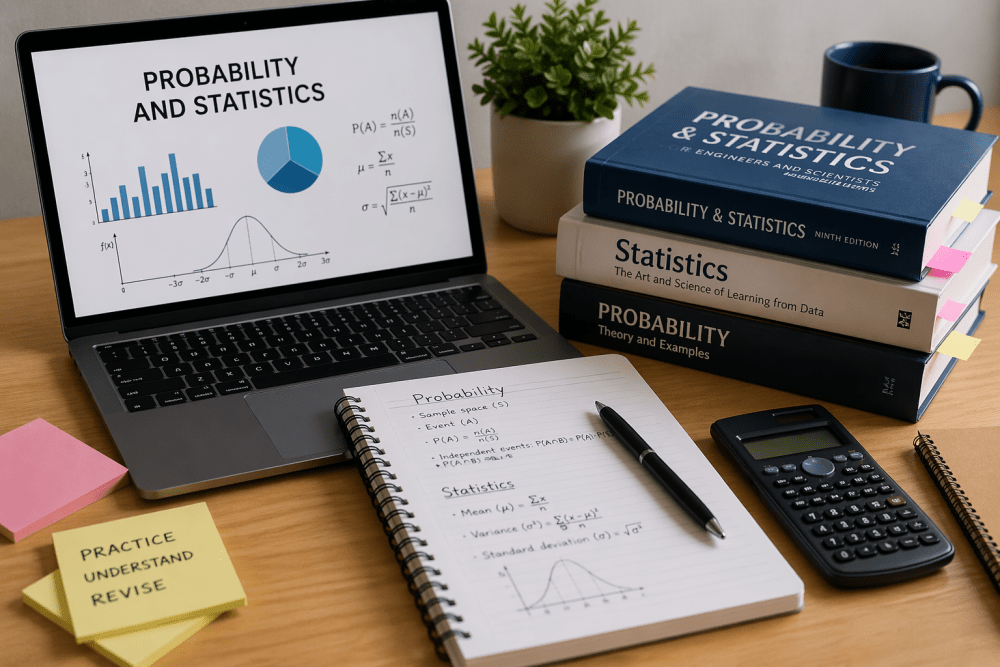
These three measures are known as measures of central tendency because they help identify the central or typical value in a dataset. Although they all describe the "average" in some way, they are calculated differently and can provide different insights.
The Mean is what most people think of when they hear the word "average." It is calculated by adding all the numbers together and then dividing by the total number of values.
Suppose five students scored:
10, 15, 20, 25, 30
Step 1: Add all values
10 + 15 + 20 + 25 + 30 = 100
Step 2: Divide by the number of values
100 ÷ 5 = 20
Mean = 20
The mean uses every value in the dataset, making it a useful measure when all data points are important.
The Median is the middle value in a dataset when the numbers are arranged in order from smallest to largest.
Data:
5, 10, 15, 20, 25
The middle value is 15.
Median = 15
Data:
10, 15, 20, 25
There are two middle numbers: 15 and 20.
Median = (15 + 20) ÷ 2
Median = 17.5
Median = 17.5
The median is particularly useful when there are extremely high or low values that could distort the mean.
The Mode is the value that appears most frequently in a dataset.
Data:
5, 8, 8, 10, 12, 15
The number 8 appears twice, while the others appear only once.
Mode = 8
A dataset can have:
Data:
2, 4, 4, 6, 6, 8
Both 4 and 6 occur twice.
Modes = 4 and 6
Consider the dataset:
2, 3, 4, 4, 5, 7, 9
2 3 4 4 5 7 9
↑
Median
Mode = 4
Mean = (2+3+4+4+5+7+9) ÷ 7
Mean = 34 ÷ 7
Mean ≈ 4.86
In this example:
Notice that the three values are similar but not exactly the same.
An outlier is a value that is much larger or smaller than the rest of the data.
Scores:
10, 12, 14, 15, 100
(10 + 12 + 14 + 15 + 100) ÷ 5
151 ÷ 5 = 30.2
Middle value = 14
No repeated value
In this case:
The score of 100 pulls the mean upward, making it less representative of the typical score. This is why statisticians often use the median when data contains outliers.
Use Mean When:
Use Median When:
Use Mode When:
Mean
A teacher calculates the average score of a class test.
Median
A property analyst finds the median house price in a city to avoid distortion from luxury homes.
Mode
A clothing store identifies the most common shirt size sold.
These measures help people make better decisions using data.
Understanding concepts such as Mean, Median, and Mode is essential for success in school mathematics and future studies. At our institute, students learn mathematical concepts through clear explanations, practical examples, and structured lessons aligned with the UK curriculum.
Whether you need support with statistics, algebra, geometry, or exam preparation, Mathsalpha provides expert guidance that helps students build confidence and improve their problem-solving skills. Our engaging learning approach makes mathematics easier to understand and apply in real-life situations.
Mean, Median, and Mode are three important measures of central tendency that help summarize data. While the mean calculates the average, the median identifies the middle value, and the mode finds the most common value.
Choosing the right measure depends on the type of data you are analyzing. Understanding the differences between these concepts allows students to interpret data more accurately and make informed decisions.
By mastering this topic, you build a strong foundation for statistics and data analysis.












.png)

.png)
.png)
.png)



.png)
.png)

.png)
.png)


.png)
1.png)






.jpeg)





See our Trustpilot Excellent Reviews