






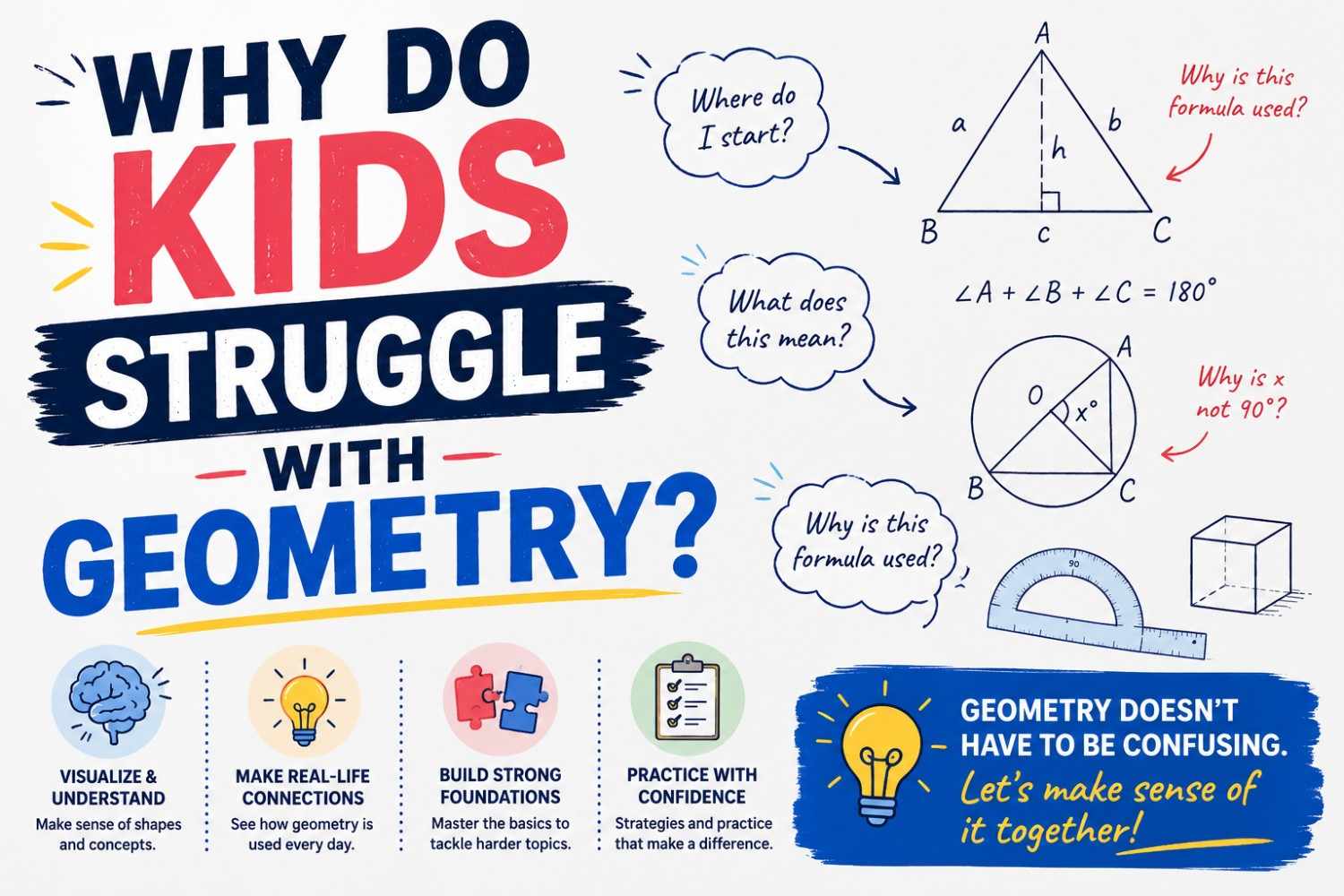
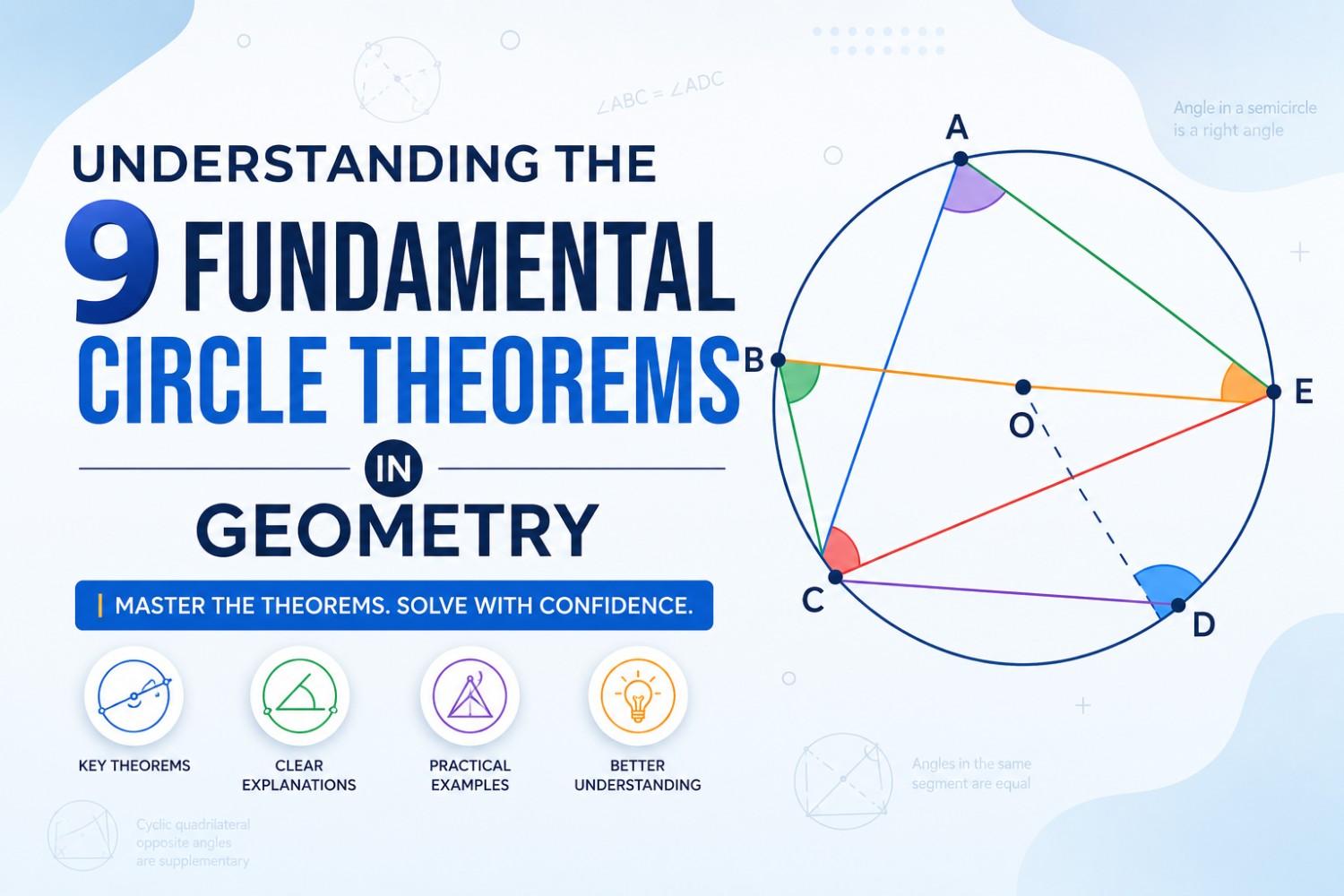
Many kids find geometry hard, and that’s normal. Geometry is a branch of maths that deals with shapes, sizes, and the space around us. It helps us understand how figures like circles, triangles, and squares work.
In geometry, we learn about lines, angles, and how shapes fit together. It asks children to imagine how things look and connect, which can feel very different from other maths topics.
Some get confused by new words like angle or parallel, while others struggle to picture shapes in their minds. But with clear examples, practice, and patience, any child can learn and enjoy geometry.
Here are some of the main reasons, backed by research and expert commentary.
|
Challenge |
What it means for the learner |
|
Unfamiliar vocabulary |
They cannot understand problem statements |
|
Poor spatial/visual reasoning |
They cannot picture shapes or transformations |
|
Over-reliance on memorisation |
They struggle when tasks deviate from standard form |
|
Weak algebraic background |
Geometry uses algebraic methods they don’t know |
|
Lack of real-life context |
They cannot relate geometry to everyday experience |
Geometry introduces many new and unfamiliar words, such as bisector, perpendicular, and congruent. If students don’t understand these terms, they can’t follow the question or solve the problem.
For example, if a child doesn’t know what a bisector means, they won’t know what to do when it appears in a task. Without a clear understanding of these words, geometry diagrams, and questions can feel like a different language.
Geometry is a visual subject. It asks students to imagine shapes, rotate them, and picture 3-D objects from 2-D drawings. Many children find this mental visualisation difficult.
Research shows that students with strong spatial thinking skills do better in geometry because they can easily imagine and manipulate shapes in their minds. Weak visual reasoning makes it harder to see how shapes connect or change, leading to confusion.
Some students focus only on memorising formulas like area = length × width or volume = base × height. This helps for simple questions, but causes problems when tasks are worded differently or require reasoning.
Geometry is not just about remembering formulas; it’s about understanding why they work. Without that understanding, children can’t apply what they’ve learned to new or complex problems.
Geometry often involves algebra, such as solving equations to find unknown angles or lengths. When a child’s algebra foundation is weak, geometry becomes much harder.
Many students are surprised to see how much algebra is used in geometry. If they have forgotten key algebra skills, they struggle to follow steps or complete problems. Strong algebra knowledge supports a better understanding of geometry.
Geometry includes abstract ideas like transformations, symmetry, and infinite lines. For many children, these are hard to grasp because they can’t see or touch them.
Without linking geometry to real-life examples, such as shapes in buildings, roads, or art, it may seem meaningless or disconnected from their world. Making geometry more practical and visual helps children see its purpose and value.
Helping children with geometry doesn’t have to be difficult. With the right approach and support, they can build confidence and enjoy learning.
Here are some simple ways to make geometry easier and more fun.
If your child finds geometry or any part of maths challenging, MathsAlpha is here to help. Our experienced tutors specialise in GCSE and A-Level Maths, guiding students from Year 7 to Year 11 with patience and care.
We offer personalised maths tutoring that builds confidence, strengthens understanding, and improves results. Whether your child needs help with geometry, algebra, or exam preparation, our tailored lessons make learning simple and effective.
Reach out to us at info@mathsalpha.com or call +44 7834 229046 to get started and watch your child’s Geometry journey thrive.

.png)
.png)
.png)
.png)
.png)
.png)
.png)
.png)
.png)
.png)
1.png)

.jpeg)


See our Trustpilot Excellent Reviews