








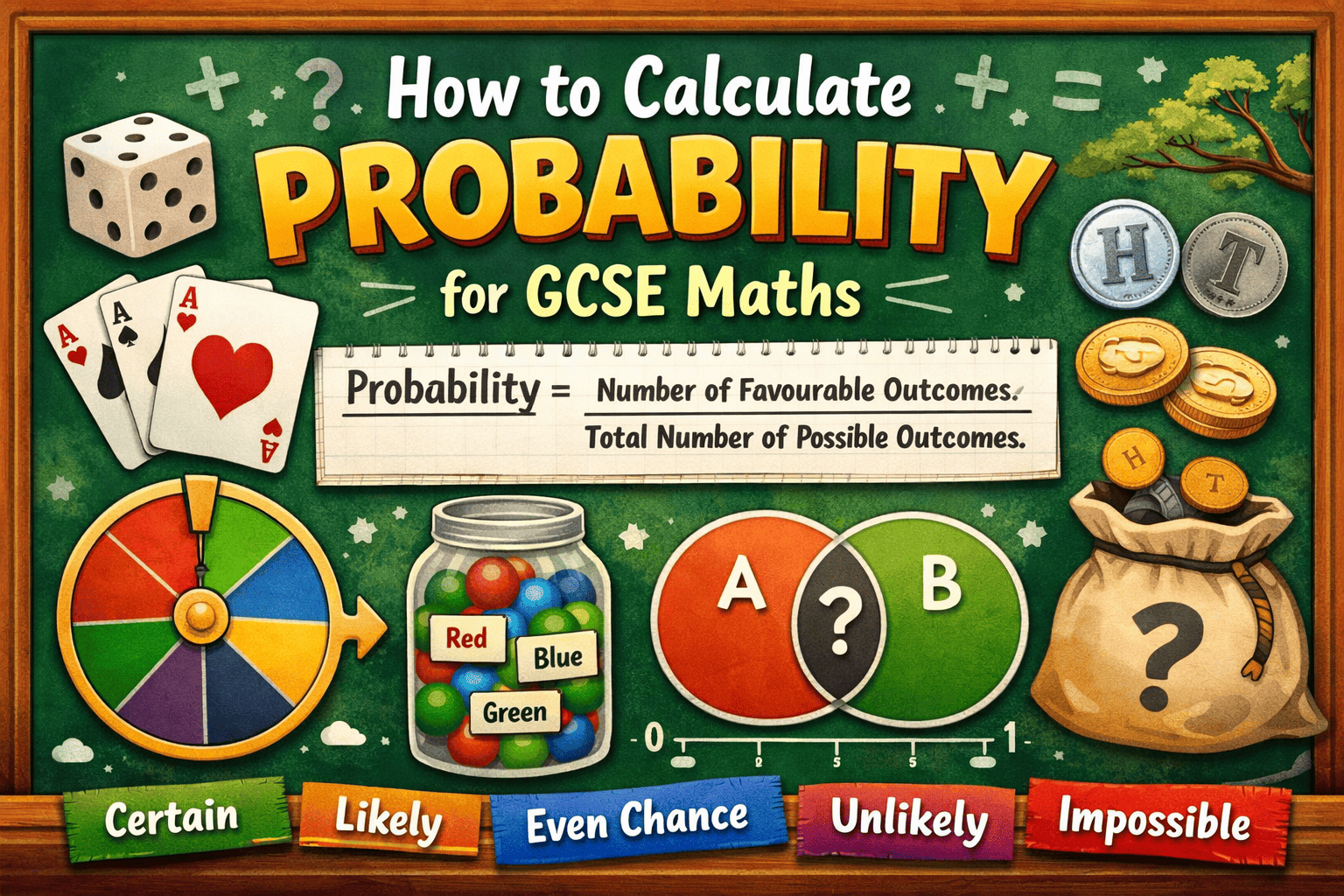
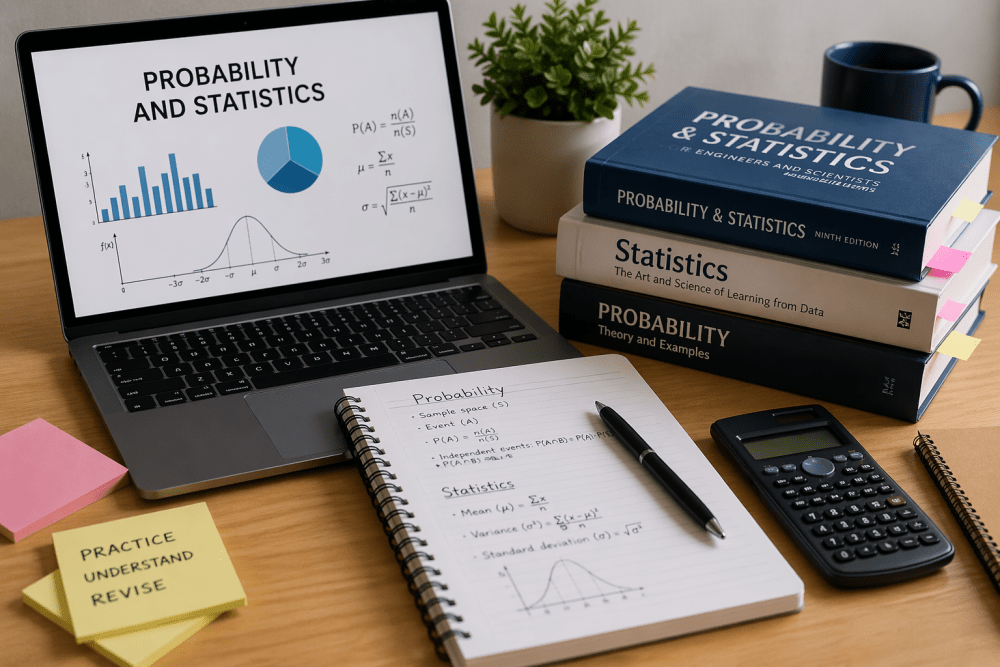
Probability is an important topic in GCSE Maths that helps us understand the chance of events happening. Whether it’s flipping a coin, rolling a dice, or picking a card, probability shows how likely something is to occur.
Learning how to calculate probability is not just about numbers but about thinking clearly and solving problems step-by-step. This blog breaks down the process into simple, easy-to-follow steps. You will learn key terms, formulas, and how to work out probability with examples you can relate to.
This helps you to solve probability questions for your GCSE exams, with useful tips and clear explanations made for students.
Probability measures the chance of an event occurring. It is a number between 0 and 1.
Two events A and B are independent when knowing that one event happens does not change the chance of the other happening.
For example, when you roll a fair die twice, the first roll does not affect the second roll.
To prove two events are independent, you only need to check one of the conditions.
If the events do affect each other, then they are called dependent events.
Here are some terms you will see often:
The main formula to calculate probability is:
Probability (P) = Number of Favorable Outcomes / Total Number of Possible Outcomes
This formula works when all outcomes are equally likely.
Identify the total number of possible outcomes. This is your denominator.
Examples
The probability scale runs from 0 to 1.
|
Probability Value |
Meaning |
|
0 |
Impossible |
|
0.5 |
Equally likely |
|
1 |
Certain to happen |
Advanced Concepts
|
Problem Type |
Formula/Approach |
Example |
|
Single event probability |
P=Favorable outcomes / Total outcomes |
Probability of rolling a 5 on a dice: 1/6 |
|
Combined events |
P(A or B)=P(A)+P(B) P(A or B)=P(A)+P(B) (if mutually exclusive) |
Probability of rolling 2 or 3: 1/6+1/6=2/6 |
|
Complementary events |
P(not A)=1−P(A) P(not A)=1−P(A) |
Probability of not rolling 4: 1−1/6=5/6 |
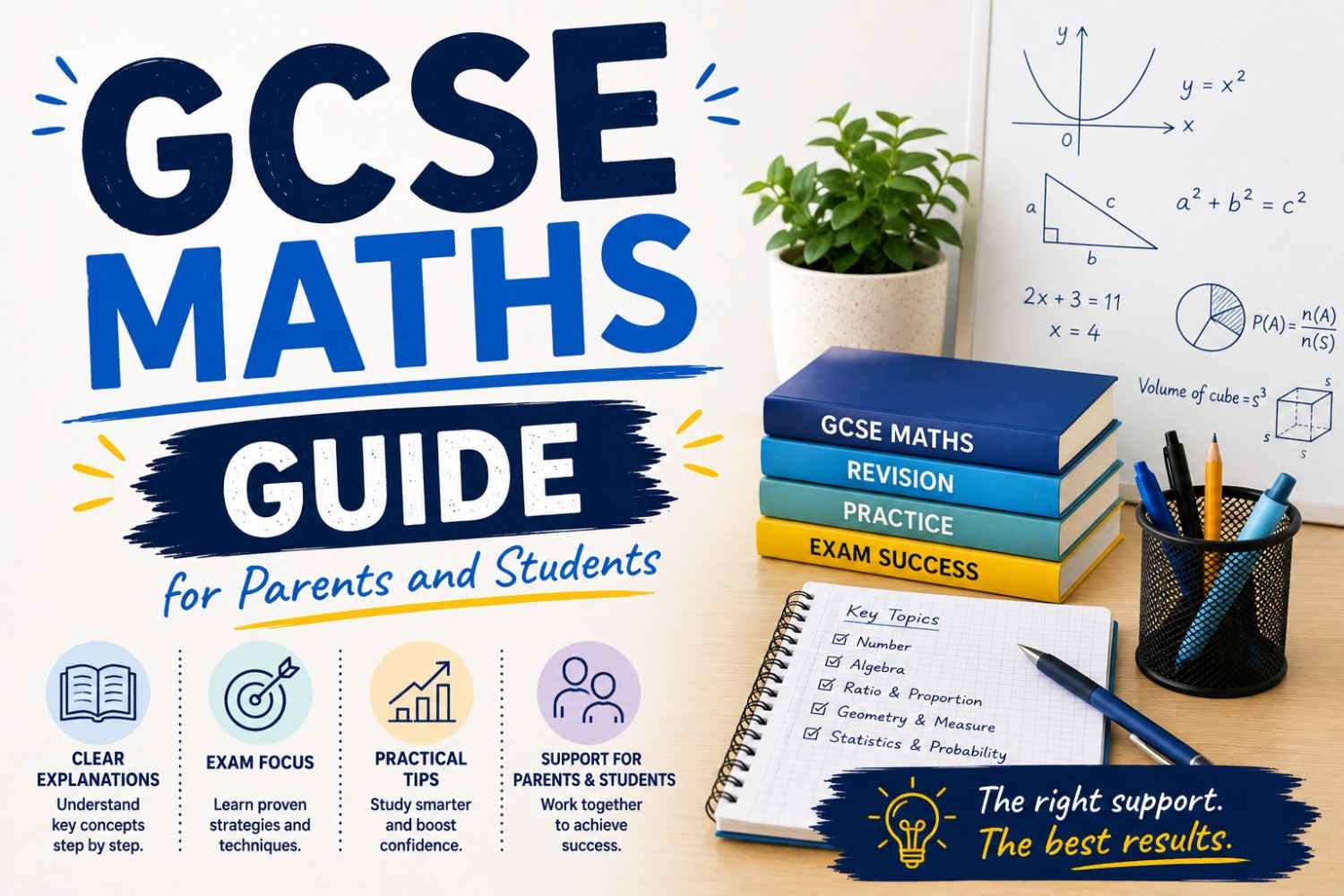
Every parent wants their child to feel confident and secure when it comes to GCSE Maths. If you’re searching for the right support to help your child understand topics like probability, our GCSE Maths tuition is here to help. We work with students from Year 7 to Year 11 across the UK, guiding them step by step through key concepts.
Contact us today for Maths classes in the UK. To get started, email us at info@mathsalpha.com or call +44 7834 229046.
What is the formula for calculating probability?
Probability = Number of favorable outcomes divided by total possible outcomes. It shows how likely an event is to happen.
What is the basic probability GCSE?
Basic probability measures how likely an event is, using a formula with favorable outcomes and total outcomes for equally likely cases.
What is the easiest way to solve probability?
List all possible outcomes, count favorable ones, then divide favorable by the total outcomes to find the probability simply and clearly.
What is the easiest way to learn probability?
Practice with real-life examples like coins or dice, use simple formulas, and draw diagrams to understand probabilities better.

.png)
.png)
.png)
.png)
.png)
.png)
.png)
.png)

.png)
.png)
1.png)

.jpeg)


See our Trustpilot Excellent Reviews