







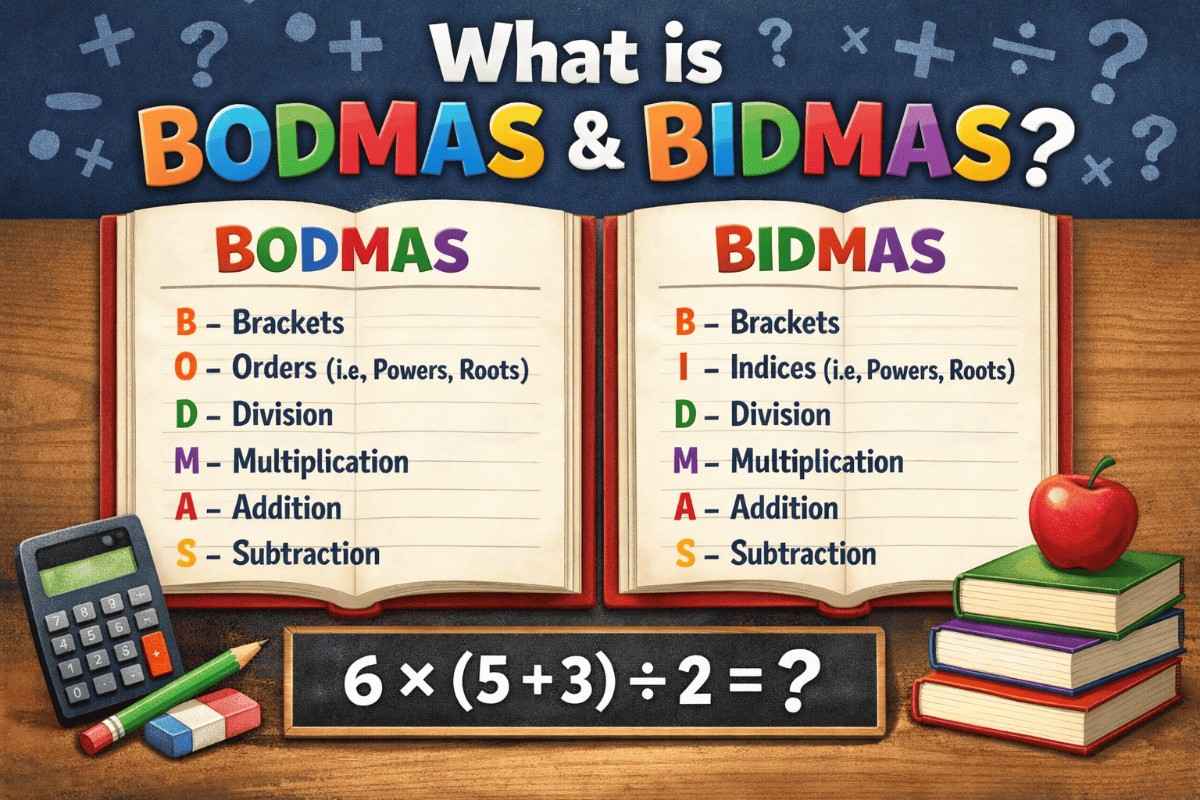
Math can become confusing when a calculation includes several numbers and symbols. In such cases, BODMAS and BIDMAS help. They are simple rules that explain the correct order to solve math problems so you get the right answer every time.
Many people make mistakes by solving calculations in the wrong order, even when the math itself is easy. Understanding BODMAS and BIDMAS makes problem-solving clearer, faster, and more accurate.
In this blog, we’ll explain what is BODMAS and BIDMAS, how they work, and how to apply them using clear and simple examples that are easy for anyone to understand.
Without rules, math causes confusion. Take 2 + 3 × 4. Some add first and get 20. Others multiply first and get 14. BODMAS or BIDMAS says multiply first. The answer is 14.
These rules act like a roadmap. They prevent mistakes. Schools teach them early. Adults use them in budgets and shopping too.
BODMAS is an easy acronym to remember. Each letter stands for a step.
|
Step |
Letter |
Full Name |
Action Example |
|
1 |
B |
Brackets |
Solve (3 + 5) = 8 first |
|
2 |
O |
Orders |
2⊃2; = 4 or √9 = 3 |
|
3 |
D |
Division |
12 ÷ 3 = 4, left to right |
|
4 |
M |
Multiplication |
4 × 2 = 8, left to right |
|
5 |
A |
Addition |
5 + 7 = 12, left to right |
|
6 |
S |
Subtraction |
10 - 2 = 8, left to right |
Division and multiplication have the same priority. Do them from left to right. Addition and subtraction work the same way.
Solve 5 + 8 × (12 ÷ 4) - 3⊃2;.
Step 1: Brackets. 12 ÷ 4 = 3. Now: 5 + 8 × 3 - 3⊃2;.
Step 2: Orders. 3⊃2; = 9. Now: 5 + 8 × 3 - 9.
Step 3: Division/Multiplication. 8 × 3 = 24. Now: 5 + 24 - 9.
Step 4: Addition/Subtraction. 5 + 24 = 29. Then 29 - 9 = 20.
Final answer: 20.
BIDMAS is very close to BODMAS. The "O" changes to "I".
BIDMAS stands for Brackets, Indices, Division, Multiplication, Addition, and Subtraction.
Indices mean powers. Like 5⊃3; or square roots. "Orders" and "Indices" are the same idea.
Both rules give the same answer. Schools may use either name, but the steps are identical. |
Example 1: 10 ÷ 2 + 3 × 4
Division/Multiplication first: 10 ÷ 2 = 5, 3 × 4 = 12.
Now: 5 + 12 = 17.
Example 2: (6 + 4)⊃2; ÷ 5 - 1
Brackets: 6 + 4 = 10.
Orders: 10⊃2; = 100.
Division: 100 ÷ 5 = 20.
Subtract: 20 - 1 = 19.
Nested Brackets: 2 × [(5 - 2) + 3⊃2;]
Inner brackets: 5 - 2 = 3.
Orders: 3⊃2; = 9.
Add: 3 + 9 = 12.
Multiply: 2 × 12 = 24.
Many mistakes happen when the order of operations is not followed correctly. Here are the most common ones and how to avoid them.
Making mistakes is normal. Every mistake helps you learn faster.
BODMAS and BIDMAS make math simple. Practice turns confusion into skill. Use them daily.
If your child finds maths topics like BODMAS or BIDMAS challenging, MathsAlpha is here to help. Our experienced tutors support students from Year 7 to Year 11, including GCSE and A-Level Maths, with patient teaching.
We provide personalised maths tutoring that builds confidence, improves understanding, and delivers real results. Each lesson is customised to your child’s learning style, making maths easier and less stressful.
To get started, email info@mathsalpha.com or call +44 7834 229046, and help your child grow in confidence and skill in maths.
1. What is the most common BODMAS mistake?
Adding or subtracting before multiplication or division, which leads to the wrong answer, even when the calculation looks simple.
2. What is the simplest way to remember BIDMAS?
Always solve brackets first, then powers, then divide and multiply, and finally add and subtract from left to right.
3. Is BODMAS useful in real life?
Yes. It helps with shopping discounts, budgeting, cooking recipes, and solving everyday maths problems correctly.



.png)
.png)
.png)
.png)

.png)
.png)
.png)
.png)

.png)
.png)
1.png)


.jpeg)



See our Trustpilot Excellent Reviews