





Gravity is one of the four fundamental forces of nature and governs everything from the motion of falling objects on Earth to the orbits of planets, stars, galaxies, and even light around black holes. Although gravity is the weakest of the fundamental forces, it has an infinite range and dominates the large-scale structure of the Universe.
In A-Level Physics, gravitational fields form one of the most important topics because they combine mathematical problem-solving with real-world applications in astronomy, engineering, and space exploration. Understanding how gravity acts between masses allows physicists to explain planetary motion, satellite orbits, and many of the remarkable phenomena observed throughout the cosmos.
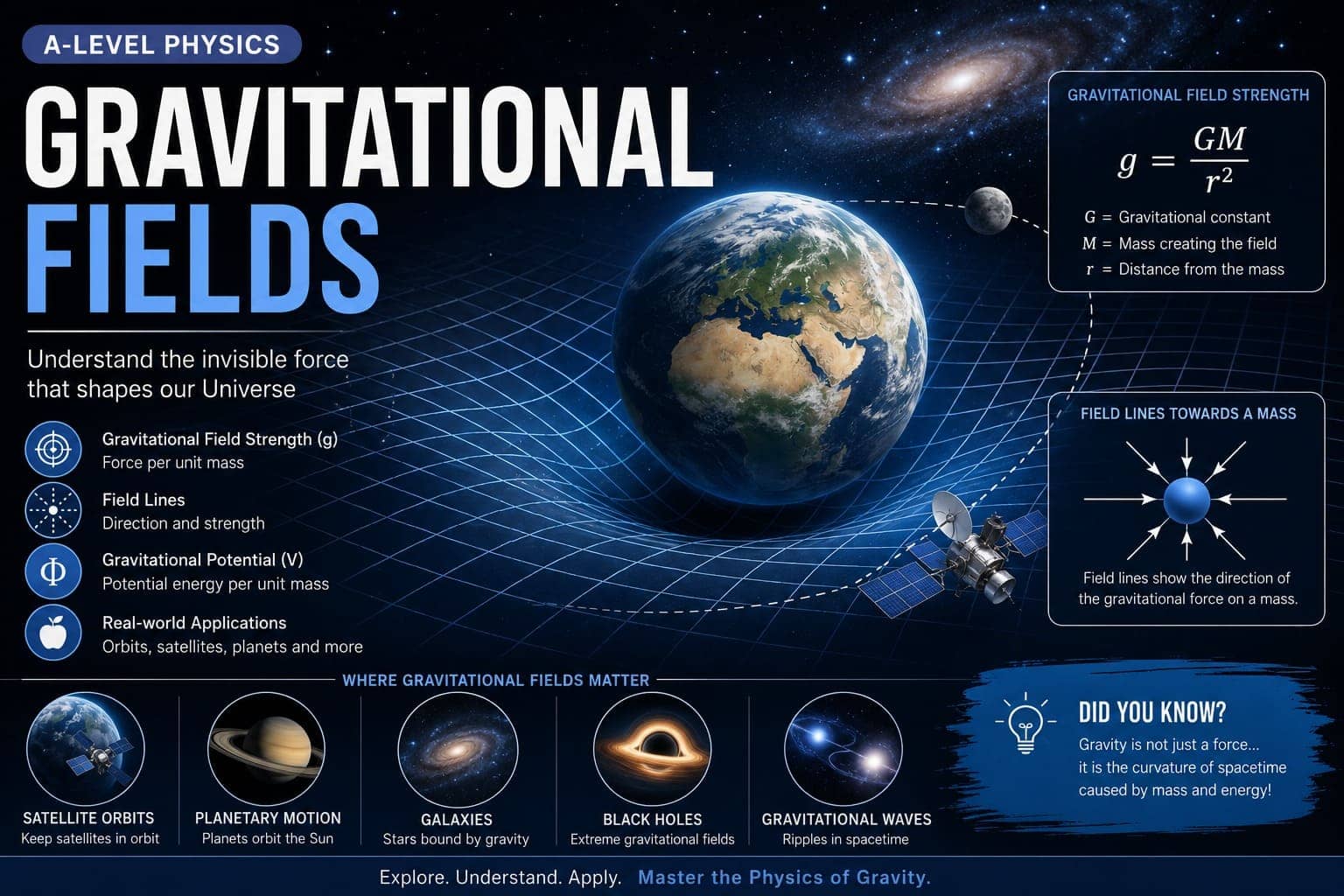
A gravitational field is the region around a mass where another mass experiences an attractive force. Every object with mass generates its own gravitational field, regardless of its size. Larger objects such as planets and stars create much stronger gravitational fields than everyday objects because of their enormous masses.
Gravitational fields are represented using field lines that point towards the centre of the object producing the field. The closer the field lines are together, the stronger the gravitational field. Unlike electric fields, gravitational fields are always attractive because mass is always positive.
Isaac Newton discovered that every object in the Universe attracts every other object through gravity. This relationship is described by Newton's Law of Universal Gravitation.
The equation shows that the gravitational force increases when either mass increases and decreases rapidly as the distance between the masses becomes larger. Because the force is inversely proportional to the square of the distance, doubling the separation reduces the force to one quarter of its original value.
| Symbol | Description | Unit |
|---|---|---|
| F | Gravitational Force | N |
| G | Universal Gravitational Constant | N m² kg⁻² |
| M, m | Masses | kg |
| r | Distance between centres | m |
Gravitational field strength tells us how strong the gravitational field is at a particular location. It is defined as the gravitational force acting on a unit mass placed within the field.
The unit of gravitational field strength is N kg⁻¹, which is equivalent to m s⁻². Near the Earth's surface, the value of g is approximately 9.81 N kg⁻¹, meaning every kilogram of mass experiences a downward force of approximately 9.81 N.
As the distance from the Earth's centre increases, gravitational field strength decreases. This explains why astronauts in orbit experience much weaker gravitational effects than people standing on the Earth's surface.
Gravitational potential describes the amount of work done per unit mass in bringing an object from infinity to a particular point within a gravitational field. Unlike gravitational field strength, gravitational potential is related to energy rather than force.
The negative sign is extremely important. It indicates that work must be done to move an object away from the gravitational field. Objects located deeper within a gravitational field have more negative gravitational potential values and require more energy to escape.
Gravitational potential energy is the energy an object possesses because of its position within a gravitational field. Near the Earth's surface, students are familiar with the equation Ep = mgh. However, for objects moving large distances from a planet or star, such as satellites and spacecraft, the more general relationship is used:
The negative value indicates that an object is gravitationally bound to the planet or star. As the object moves further away, its gravitational potential energy becomes less negative and approaches zero at an infinite distance. This concept is essential when studying satellite motion, escape velocity, and space missions.
One of the most fascinating applications of gravitational fields is orbital motion. Planets orbit the Sun, moons orbit planets, and thousands of artificial satellites orbit the Earth. These objects remain in orbit because gravity continually provides the centripetal force needed to change the direction of their motion.
Without gravity, a satellite would travel in a straight line due to Newton's First Law of Motion. Instead, gravity constantly pulls it towards the Earth, causing it to follow a circular or elliptical path.
By equating gravitational force to centripetal force, physicists can calculate orbital speed, orbital radius, and orbital period. These calculations are frequently tested in A-Level Physics examinations.
| Object | Typical Orbit | Purpose |
|---|---|---|
| GPS Satellite | Medium Earth Orbit | Navigation and positioning |
| Weather Satellite | Geostationary Orbit | Weather forecasting |
| Communication Satellite | Geostationary Orbit | Television, internet and telecommunications |
| International Space Station | Low Earth Orbit | Scientific research |
Escape velocity is the minimum speed an object must have to leave a planet's gravitational field without any further propulsion. For the Earth, the escape velocity is approximately 11.2 km s−1.
Escape velocity depends only on the mass and radius of the planet. Surprisingly, it does not depend on the mass of the object being launched. Whether it is a small probe or a large spacecraft, the required escape velocity remains the same.
Gravitational field theory is used extensively in science and engineering. Engineers calculate satellite orbits to ensure reliable GPS navigation, weather forecasting, television broadcasting, and global communications. Space agencies such as NASA and ESA use gravitational calculations when planning missions to the Moon, Mars, and beyond.
Astronomers also use gravitational field equations to study binary stars, exoplanets, galaxies, and black holes. Modern discoveries such as gravitational waves have demonstrated that gravity continues to play a central role in expanding our understanding of the Universe.
Gravitational fields provide one of the most powerful tools for understanding the Universe. From the motion of satellites around the Earth to the orbits of planets around the Sun, gravity governs the behaviour of objects across vast distances. By mastering Newton's Law of Universal Gravitation, gravitational field strength, gravitational potential, gravitational potential energy, and orbital motion, students develop the mathematical and conceptual skills needed to solve a wide range of A-Level Physics problems.
Success in this topic comes from understanding the physical meaning behind each equation rather than simply memorising formulas. Practise deriving equations, solving numerical problems, and interpreting diagrams, and you'll be well prepared for examinations. With a solid grasp of gravitational fields, you'll also gain a deeper appreciation of how gravity shapes everything from everyday life on Earth to the evolution of stars, galaxies, and the Universe itself.
Join our GCSE and A-Level Physics tutoring programmes and discover how expert guidance can help you achieve outstanding examination results.
Book Your Free Assessment
.png)
.png)
.png)
.png)

.png)
.png)
.png)
.png)


.png)
.png)
1.png)


.jpeg)




See our Trustpilot Excellent Reviews