







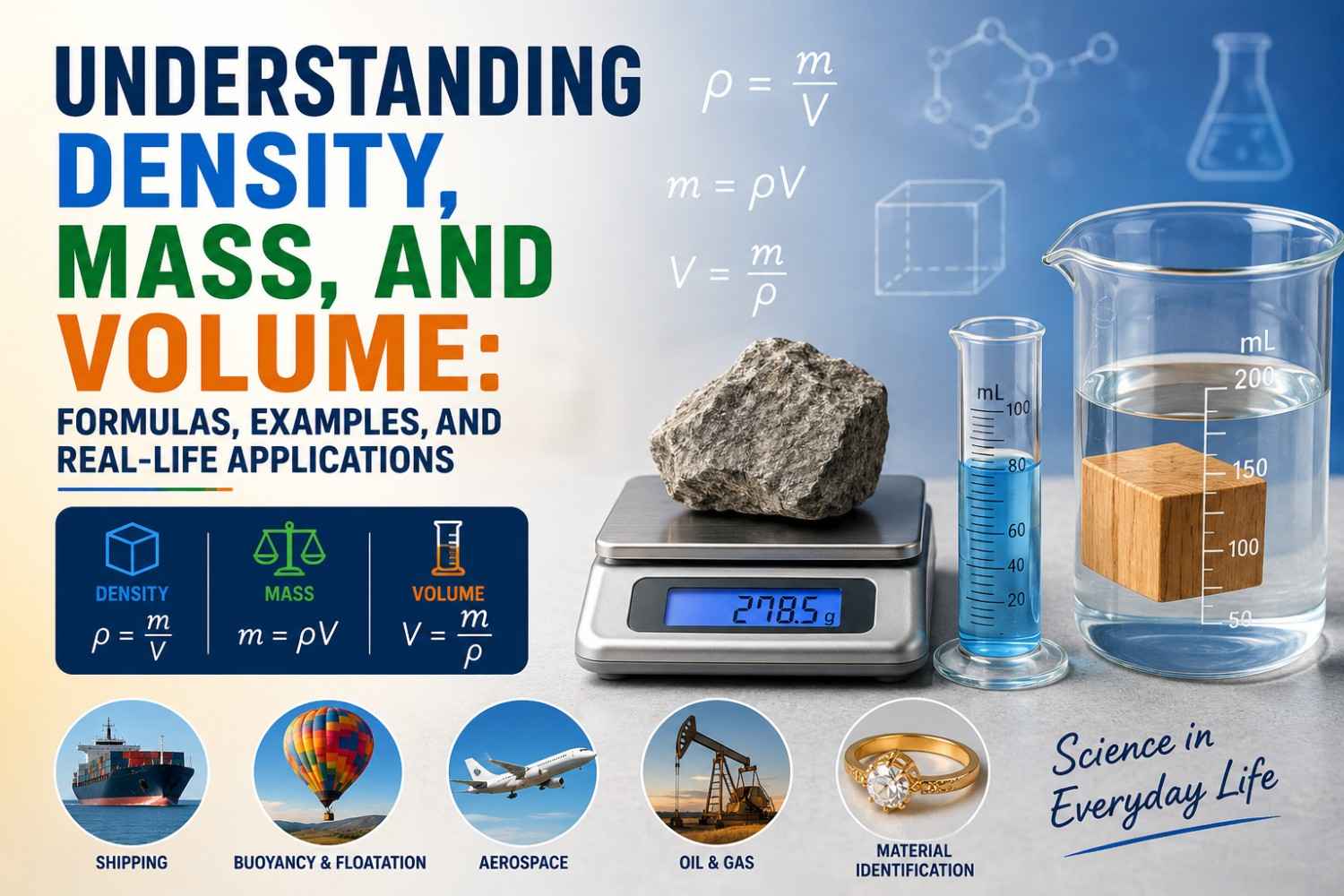
Have you ever wondered why a small stone sinks in water while a large ship floats? Or why some objects feel heavier than others even when they are the same size? The answer lies in three important scientific and mathematical concepts: density, mass, and volume.
These concepts are closely connected and help us understand how materials behave in the world around us. From cooking and construction to engineering and medicine, density, mass, and volume play a vital role in everyday life.
In this guide, you will learn the meaning of density, mass, and volume, their formulas, practical examples, and real-life applications in a simple and easy-to-understand way.
Density, mass, and volume are three important concepts used in mathematics, physics, chemistry, and everyday life. These measurements help us understand the properties of different objects and materials around us.
Mass is the amount of matter present in an object. It tells us how much material an object contains.
For example:
Mass is usually measured in:
Volume is the amount of space occupied by an object.
For example:
Volume is commonly measured in:
Density describes how tightly matter is packed inside an object.
Density helps explain why some materials float while others sink.
Density, mass, and volume are connected through a simple formula:
These formulas are widely used in mathematics, science, and engineering.
|
Quantity |
Formula |
Unit |
|
Density |
Density = Mass ÷ Volume |
kg/m³ or g/cm³ |
|
Mass |
Mass = Density × Volume |
kg or g |
|
Volume |
Volume = Mass ÷ Density |
m³, cm³, or L |
Understanding units is important when solving problems.
|
Quantity |
SI Unit |
|
Mass |
Kilogram (kg) |
|
Volume |
Cubic Meter (m³) |
|
Density |
Kilogram per Cubic Meter (kg/m³) |
Example 1
A block has a mass of 200 grams and a volume of 50 cm³.
Using the formula:
Density = Mass ÷ Volume
Density = 200 ÷ 50
Density = 4 g/cm³
Answer: The density of the block is 4 g/cm³.
Example 2
A metal object has a density of 8 g/cm³ and a volume of 25 cm³.
Mass = Density × Volume
Mass = 8 × 25
Mass = 200 grams
Answer: The mass of the object is 200 grams.
Example 3
A substance has a mass of 300 grams and a density of 6 g/cm³.
Volume = Mass ÷ Density
Volume = 300 ÷ 6
Volume = 50 cm³
Answer: The volume is 50 cm³.
Density is not just a classroom concept. It has many practical uses.
Engineers calculate density when designing ships.
Although ships are made from heavy metals, their overall density is kept lower than water because of the large amount of air inside them.
This allows them to float.
Aircraft designers consider density when calculating lift and fuel efficiency.
Air density affects how planes take off and fly.
Builders use density measurements to select suitable materials for buildings, roads, and bridges.
Dense materials often provide greater strength and durability.
Different liquids have different densities.
Engineers use density measurements to separate oil, water, and other substances.
Doctors and laboratories use density-based tests to analyze blood samples and other fluids.
Density helps manufacturers maintain product consistency in beverages, dairy products, and packaged foods.
Mass is used in many areas of daily life.
Volume measurements are important in everyday situations.
Examples:
Density, mass, and volume are three important concepts taught to students from GCSE through A-Level Students and form a key part of science and mathematics education. These topics become especially important in GCSE Science, where students learn how to calculate density, use formulas, and apply these concepts to real-world situations.
By understanding these concepts, students can improve their problem-solving skills, perform scientific calculations accurately, and build a strong foundation for GCSE and A-Levels, and future STEM studies.
Students looking for extra support can strengthen their understanding through expert guidance and practice. MathsAlpha provides online maths tutoring for Year 6 to Year 13 students, helping learners master topics such as density, mass, volume, measurements, and other key GCSE and A-Level concepts with confidence.
• Mass measures the amount of matter in an object.
• Density measures how closely the matter is packed in a given volume.
Example: A kilogram of cotton and a kilogram of iron have the same mass. However, iron has a much higher density because its particles are packed more tightly together, while cotton takes up more space.


.png)
.png)
.png)
.png)


.png)
.png)

.png)
.png)


.png)
.png)
1.png)




.jpeg)




See our Trustpilot Excellent Reviews