








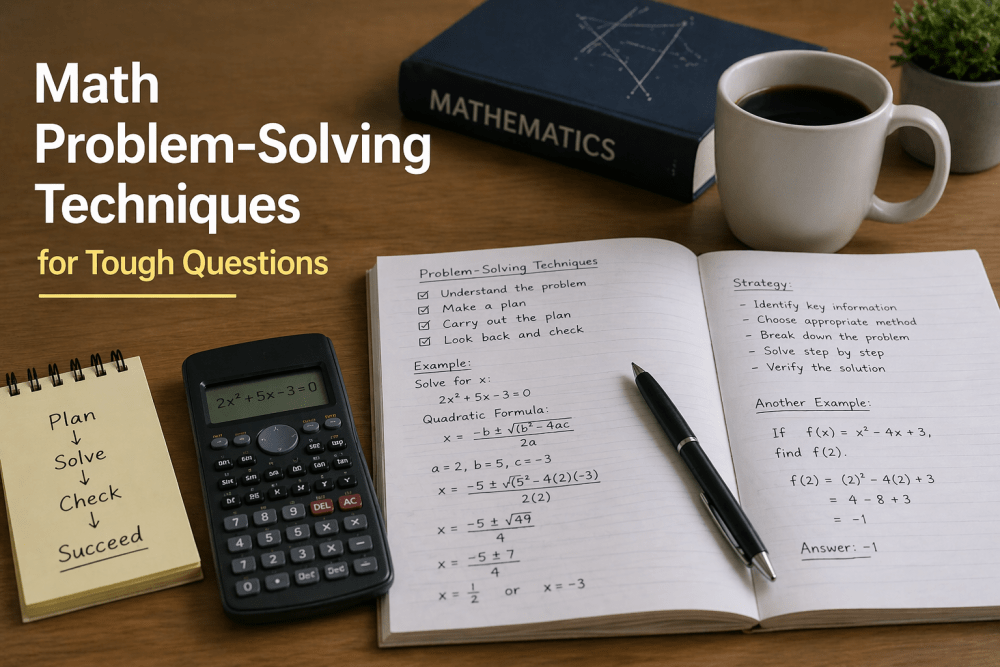
Do tough maths questions make you feel stuck or confused? Many students feel nervous when they see long word problems or tricky calculations. But the important thing is that you can solve even the hardest questions with the right approach.
Strong math problem-solving skills are not about being “naturally smart.” They are about using simple strategies step by step. When you learn how to read carefully, think clearly, and organise your work, maths becomes much easier.
In this blog, you will find practical and easy techniques that help you stay calm, confident, and in control during lessons and exams. Let’s explore them together.
Let’s explore strategies and techniques that will help you handle tough questions with confidence.
Think of this strategy as your personal problem-solving checklist. Follow it every time you face a tricky question.
Read Carefully
Start by reading the question slowly.
Read it at least twice.
Underline or circle:
Many mistakes happen because students rush and miss small details.
Visualize
Create a picture in your mind and draw it.
For example:
If a question says, “4 children share 12 candies equally,” draw:
When you see the problem, your brain understands it better. Visualization turns abstract numbers into something real.
Plan
Before jumping into calculations, stop and think:
Planning saves time by preventing random guessing.
Solve
Now solve step by step. Write neatly. Show all your working.
If the problem has more than one step:
Never skip steps in tough questions.
Check
Always check your answer.
Ask yourself:
Checking builds accuracy and confidence.
This full method strengthens your math problem solving skills because it trains you to think clearly at every stage.
Many students underestimate this technique, but it is extremely helpful.
When numbers feel confusing, pictures make them easier to understand.
If a question says:
“Tom has 3 boxes. Each box has 5 pencils. How many pencils are there?”
Draw:
Now you clearly see:
5 + 5 + 5 = 15
or
3 × 5 = 15
Pictures turn difficult math problem solving into something visual and friendly.
Big problems look scary because they combine many ideas together. Break the problem into smaller steps for easy understanding.
Example
A school bought 24 notebooks. They packed them equally into 6 bags. Then each bag was given to 2 classes equally. How many notebooks did each class get?”
Instead of panicking:
Step 1: 24 ÷ 6 = 4 notebooks per bag
Step 2: 4 ÷ 2 = 2 notebooks per class
Final answer: 2 notebooks per class.
When you break it down, it becomes manageable.
This method improves math problem-solving by reducing confusion and keeping your thinking organised.
Sometimes a question gives the final result and asks what happened before.
In such cases, working backwards saves time.
Example
“A number was multiplied by 4 and then 6 was added. The result is 26. What is the number?”
Work backwards:
Start with 26
Subtract 6 → 20
Divide by 4 → 5
The original number is 5.
This technique makes complex math problem solving easier because you undo each step one by one.
Patterns appear everywhere in mathematics.
Recognising patterns helps you:
Example 1: Number Pattern
2, 4, 6, 8, ___
You see the pattern: +2
Next number: 10
Example 2: Multiplication Pattern
5, 10, 15, 20
Each number increases by 5.
Patterns also appear in:
Pattern recognition strengthens your overall math problem solving ability.
When a problem gives a lot of information, your brain may feel overloaded.
Tables organise information clearly.
Tables help you:
When to use tables:
Following these simple steps will help you stay calm, focused, and confident during your exams.
Tough maths questions may look difficult at first, but you can solve them with the right strategies. When you read carefully, draw pictures, break problems into smaller steps, look for patterns, and check your answers, you make math problem solving much easier. These simple techniques help you think clearly and avoid careless mistakes.
Remember, practice makes progress. The more you use these methods, the more confident you will feel in class and exams. Stay calm, trust your steps, and never give up. With the right approach, you can handle even the toughest maths questions successfully.
Every parent wants their child to succeed in Maths. MathsAlpha offers expert maths tutoring for students from Year 7 to Year 11 across the UK. We provide personalised lessons that help students understand topics clearly, build confidence, and improve their exam performance.
Contact us today to book maths tutoring and give your child the support they need. To get started, email us at info@mathsalpha.com or call +44 7834 229046. Together, we can make maths easier and exams less stressful.










.png)
.png)
.png)
.png)

.png)
.png)
.png)
.png)


.png)
.png)
1.png)


.jpeg)



See our Trustpilot Excellent Reviews