








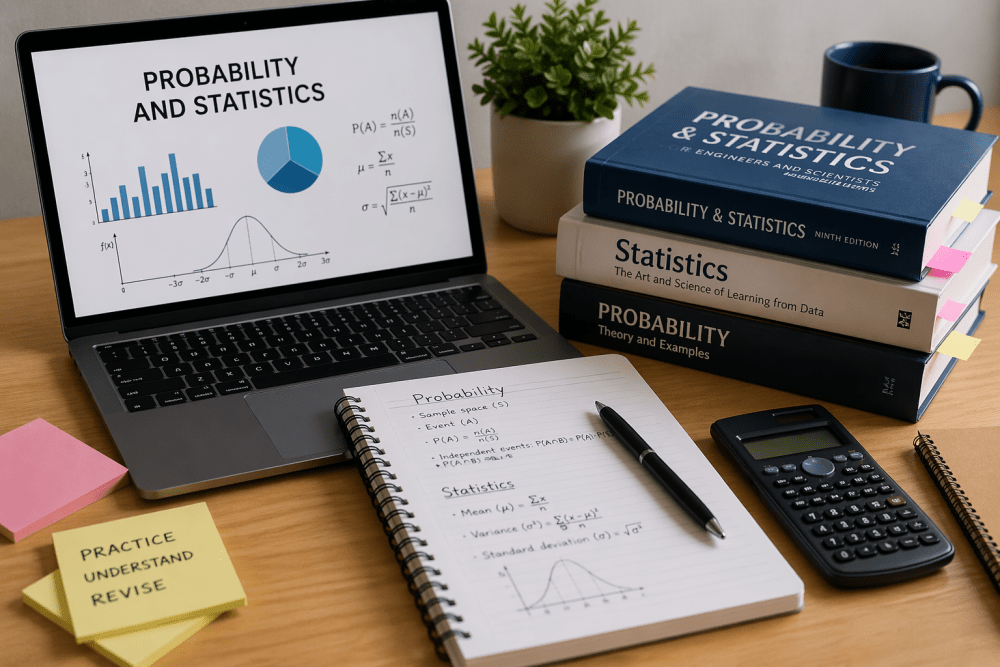
Scoring high marks in probability and statistics is possible with the right strategy, consistent practice, and a clear understanding of core concepts. Many students across the UK find this topic challenging because it combines logical thinking, formulas, interpretation, and problem-solving skills. However, with a structured approach and expert guidance, you can turn it into one of your strongest areas in maths.
This guide explains practical steps to help you improve performance, avoid common mistakes, and build confidence before exams.
The first step to mastering probability and statistics is understanding the foundations. Without clarity in basics, advanced questions become difficult.
Focus on:
Instead of memorising formulas blindly, understand how they work.
For example, when calculating probability, always ask yourself, "What is the total possible outcome?” and “What is the favorable outcome?”
When your concepts are strong, complex exam questions become easier to break down.
In probability and statistics, practice is everything. Reading theory alone will not improve your score.
Use:
Practicing under time conditions helps improve speed and accuracy. Many students lose marks not because they do not know the topic, but because they misread the question or run out of time.
After solving questions, always review:
Learning from mistakes is one of the fastest ways to improve.
In probability and statistics, calculation accuracy is crucial. Small mistakes in decimal places or rounding can cost marks.
Make sure you:
Examiners award method marks, so never skip steps.
Statistics questions often test your ability to interpret data rather than just calculate it.
For example, you may be asked to do the following:
To score better in probability and statistics, practice writing short, clear explanations. Use mathematical language such as the following:
Clear explanation answers can secure easy marks.
Probability questions are often presented as word problems. These can look confusing at first.
To simplify:
Visual tools like tree diagrams make probability questions much easier to solve.
When tackling probability and statistics questions, always convert words into mathematical form before solving.
Examiners often test common mistakes. Be careful about:
Reading the question carefully can prevent losing unnecessary marks.
Do not leave probability and statistics revision until the last minute.
Create a weekly revision plan:
Short, regular study sessions improve long-term memory and reduce exam stress.
Active revision methods include:
Sometimes students struggle because they lack personalised feedback. An experienced tutor can quickly identify weaknesses and provide targeted practice.
This is where MathsAlpha, known as the Online Math Tutor in UK, can make a big difference. MathsAlpha provides structured lessons, exam-focused practice, and step-by-step explanations tailored to GCSE and A-Level students.
With personalised online sessions, students can:
Having expert support ensures you stay on track and avoid common mistakes.
Success in probability and statistics is not about memorising formulas only. It is about thinking logically.
Train your brain to:
For example, probability answers must always lie between 0 and 1. If your answer is 1.5, you know something is wrong.
Developing this checking habit can instantly boost your marks.
Exam performance depends not only on preparation but also on mindset.
During the exam:
Confidence plays a huge role in scoring better in probability and statistics.
Improving your score in probability and statistics is completely achievable with the right approach. Focus on understanding concepts, practice consistently, improve interpretation skills, and learn from mistakes. Avoid rushing, manage your time wisely, and always show full work.
If you want expert guidance and personalised support, MathsAlpha, the trusted Online Math Tutor in UK, offers structured online tuition designed to help students excel in exams. With the right mentor and smart study strategy, you can turn probability and statistics into a high-scoring subject and achieve your academic goals.
Enroll now with MathsAlpha and start mastering maths with expert online guidance tailored for UK students.
Understand the core concepts first, then practice past papers regularly. Review mistakes to improve accuracy and speed.
Break questions into steps, use diagrams, and practice word problems under timed conditions.
Students often misread questions, confuse key terms, or make calculation errors. Always check your work.
Consistent weekly practice with mixed exam questions is more effective than last-minute revision.
Yes, expert guidance and personalised practice from tutors like MathsAlpha can improve understanding and exam performance.











.png)
.png)
.png)
.png)

.png)
.png)
.png)
.png)




.png)
.png)
1.png)



.jpeg)




See our Trustpilot Excellent Reviews