







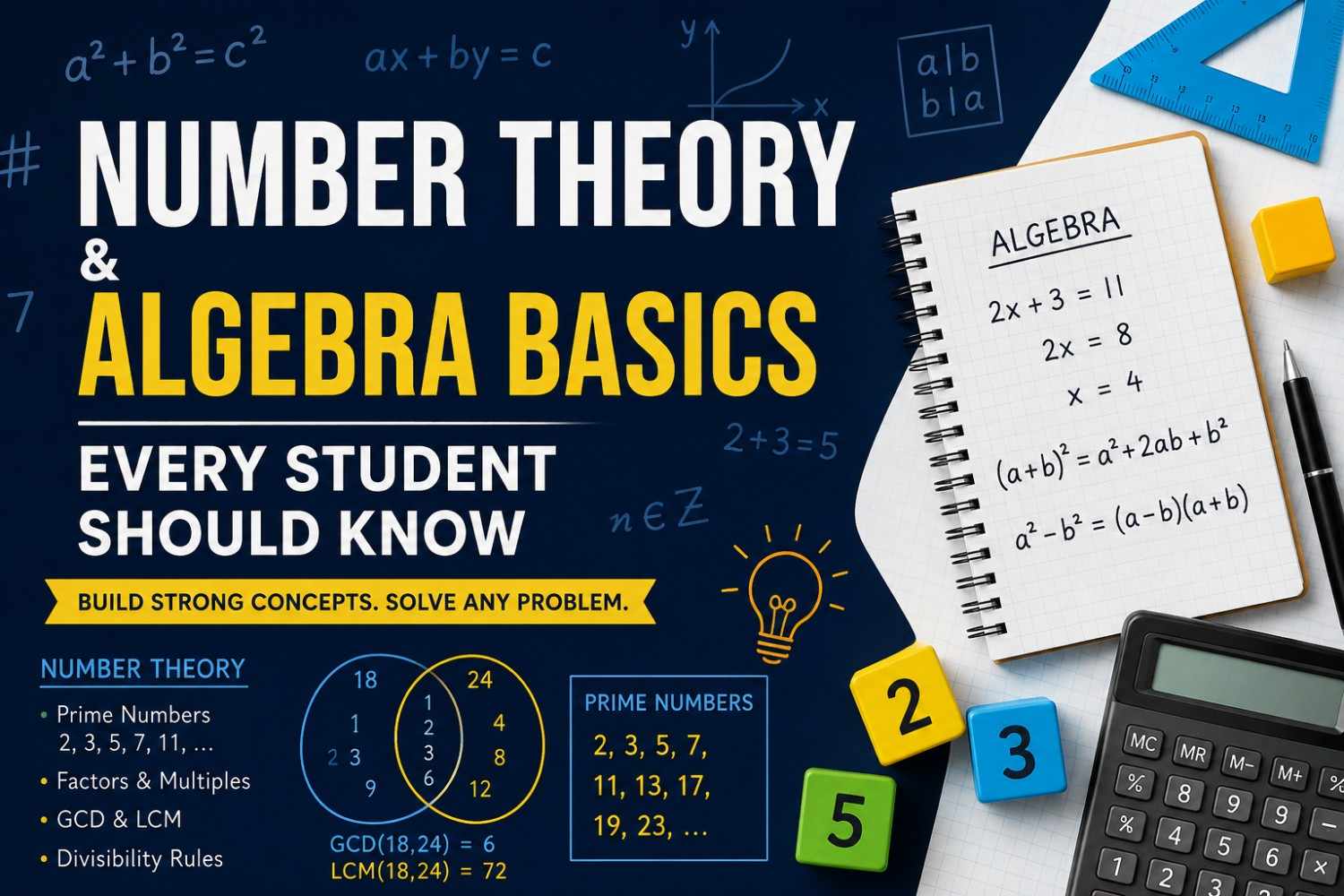
Mathematics is often called the language of logic, and two of its most important branches are Number Theory and Algebra. These subjects form the foundation for advanced mathematics, computer science, engineering, finance, and many real-world problem-solving applications.
Whether you are a school student preparing for exams or someone looking to strengthen mathematical skills, understanding the basics of number theory and algebra is essential.
Number Theory is the study of integers and their properties. It deals with how numbers behave, relate to one another, and can be manipulated through mathematical
operations.
A prime number is a number greater than 1 that has exactly two factors: 1 and itself. Examples include 2, 3, 5, 7, and 11.
A composite number has more than two factors. Examples include 4, 6, 8, and 12.
Prime numbers are the building blocks of mathematics because every composite number can be expressed as a product of prime numbers.
For example:
Understanding factors and multiples helps students solve divisibility and fraction-related problems efficiently.
The Greatest Common Divisor (GCD) of two numbers is the largest number that divides both without leaving a remainder.
Example:
The GCD of 18 and 24 is 6.
The Least Common Multiple (LCM) is the smallest positive number divisible by both given numbers.
Example:
The LCM of 4 and 6 is 12.
LCM is particularly useful when adding or subtracting fractions with different denominators.
Quick divisibility tests save time during calculations:
These rules help simplify arithmetic and number theory problems.
Important properties include:
Recognizing these patterns is useful in problem-solving and proofs.
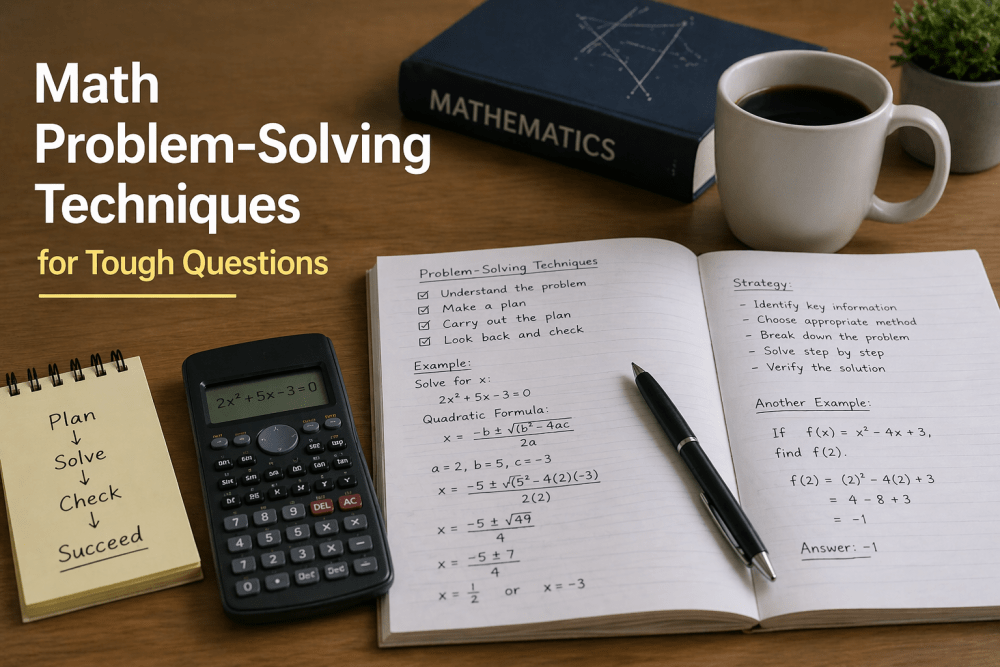
Algebra extends arithmetic by introducing variables, symbols that represent unknown values.
In algebra:
Example:
x + 5 = 12
Here, x is the variable, and 5 and 12 are constants.
An algebraic expression combines variables, constants, and operations.
Examples:
Expressions do not contain equality signs.
A linear equation contains variables raised only to the first power.
Example:
2x + 4 = 12
Subtract 4 from both sides:
2x = 8
Divide by 2:
x = 4
Learning to solve equations is one of the most important algebraic skills.
Like terms have identical variable parts.
Example:
3x + 5x = 8x
However:
3x + 5y cannot be combined because the variables differ.
Combining like terms simplifies expressions and equations.
The distributive property allows multiplication across terms inside brackets.
Example:
3(x + 4)
Expands to:
3x + 12
This concept is fundamental for simplifying algebraic expressions.
Certain formulas appear repeatedly in mathematics.
One common identity is:
(a + b)² = a² + 2ab + b²
Another important identity is:
a² - b² = (a+b) (a-b)
Memorizing and understanding these identities helps students solve problems quickly.
Algebra and geometry often work together. A coordinate plane uses x and y axes to locate points.
Example:
Graphs help visualize equations and relationships between variables.
For example, a quadratic function can be represented graphically:
y = x² - 4x + 3
Visual understanding often makes algebra easier to learn.
A function assigns exactly one output to each input.
Example:
f(x) = 2x + 1
If x = 3:
f(3) = 2(3) + 1 = 7
Functions are central to advanced mathematics, science, and programming.
Number theory develops logical thinking and strengthens arithmetic skills. Algebra introduces abstract reasoning and problem-solving techniques. Together, they form the backbone of higher mathematics and many STEM disciplines.
Students who master these fundamentals often find advanced topics such as calculus, statistics, cryptography, computer programming, and data science much easier to understand. Strong foundations also improve performance in competitive exams and academic assessments.
MathsAlpha is a modern learning platform dedicated to making mathematics simple, engaging, and accessible for students of all levels. The platform focuses on building strong conceptual understanding through clear explanations, practical examples, problem-solving strategies, and interactive learning resources.
From foundational topics like arithmetic, number theory, and algebra to advanced subjects such as calculus, statistics, and competitive exam preparation, MathsAlpha helps learners strengthen their mathematical skills with confidence.
Its mission is to transform the way students learn mathematics by combining quality educational content, structured learning paths, and innovative teaching methods that encourage curiosity, critical thinking, and academic excellence.
Number theory and algebra are not just school subjects; they are essential tools for analytical thinking and real-world problem-solving. Concepts such as prime numbers, factors, GCD, LCM, variables, equations, identities, and functions appear repeatedly throughout mathematics and science.
By developing a solid understanding of these basics, students gain confidence, improve logical reasoning, and prepare themselves for future academic and professional success.
Q1: How should I study Number Theory if I really don't understand any of it?
Ans: Start with the basics like whole numbers, primes, factors, and divisibility. Use simple examples, practice problems, and gradually move to harder topics.
Q2: What are the fundamentals of algebra that I should know?
Ans: Learn about variables, constants, expressions, equations, and how to solve for unknowns. Also, understand simple operations like addition, subtraction, multiplication, and division with variables.
Q3: Is number theory interesting to learn?
Ans: It’s full of patterns, puzzles, and problems that make math fun and improve problem-solving skills.
Q4: What should be learnt before learning number theory?
Ans: You should know basic arithmetic: addition, subtraction, multiplication, division, factors, multiples, and prime numbers. This makes number theory much easier to understand.

.png)
.png)
.png)
.png)

.png)
.png)

.png)

.png)

.png)
.png)
1.png)




.jpeg)




See our Trustpilot Excellent Reviews