








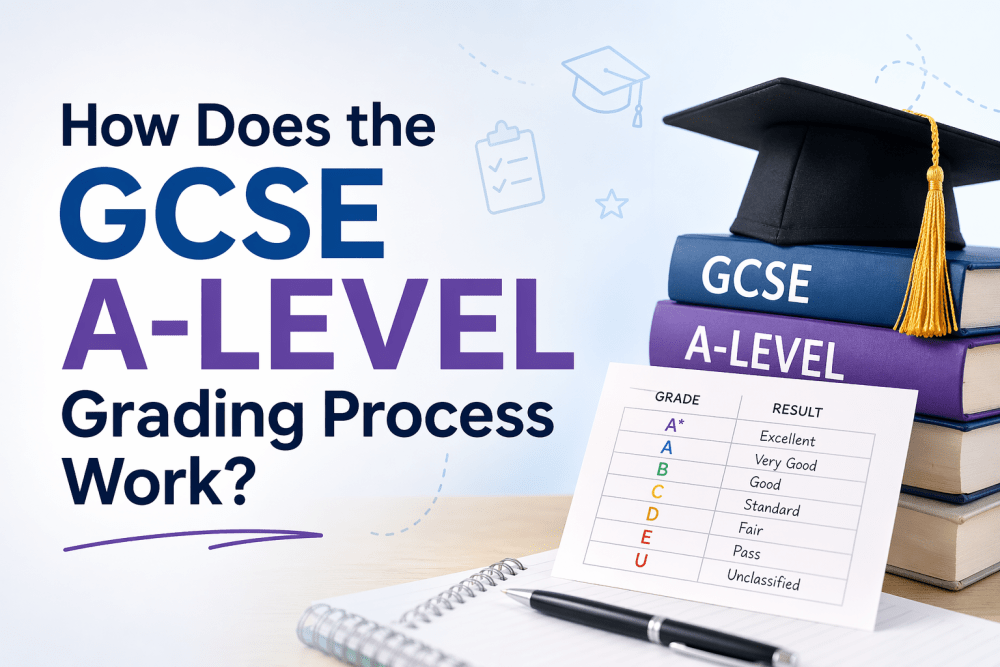
Many students and parents wonder how exam marks turn into final GCSE and A-level grades. If you’ve ever asked yourself how exam boards decide grade boundaries or why they change each year, you’re not alone.
Understanding the GCSE A-level grading process helps reduce confusion and shows how fairness and consistency are maintained across different exam years.
In this guide, we’ll explain everything step by step, from marking exams to setting grade boundaries and awarding final results in simple and clear language.
The GCSE A-level grading process is how exam boards turn exam marks into final grades. The main aim is to be fair. Students should need the same level of performance to get a certain grade, no matter which year they take the exam.
This means:
Even though exam papers may feel easier or harder each year, grading methods ensure students are judged fairly.
Here’s a simple overview of the GCSE A-level grading process:
|
Step |
What Happens |
|
1 |
Students sit exams or complete assessments |
|
2 |
Scripts are marked anonymously by trained examiners |
|
3 |
Exam boards analyse results data |
|
4 |
Grade boundaries are set |
|
5 |
Final grades are awarded |
|
6 |
Results are sent to schools and students |
L
et’s break each step in detail:
The process begins when students complete:
Each subject has specific assessment methods depending on the exam board and qualification.
After exams finish, papers are sent to exam boards for marking.
One of the most important parts of the gcse a-level grading process is accurate marking.
Here’s how exam boards ensure fairness:
Anonymous Marking
Mark Schemes
Examiners follow detailed marking guides. These include:
Quality Checks
This ensures everyone is assessed using the same standards.
After marking, students receive raw marks, which are simply the total marks scored.
Example:
This is often the most misunderstood part of the GCSE A-level grading process. Grade boundaries decide how many marks are needed to achieve each grade, and they are set carefully to make sure grading stays fair and consistent.
How Exam Boards Decide Grade Boundaries
Exam boards use several methods when setting grade boundaries:
1. Data Analysis
They analyse different types of information, including:
2. Expert Review
Senior examiners carefully review exam papers by:
3. Maintaining Standards
The main goal is to keep grading standards consistent over time, not to control how many students pass or fail.
This means:
Once grade boundaries are finalised:
So if the boundary for Grade 7 is 70 marks:
Although the process is similar, grading scales differ.
|
New Number Grades |
Old Letter Equivalent |
|
9 |
Higher than A* |
|
8 |
Between A* and A |
|
7 |
A |
|
6 |
High B |
|
5 |
Strong pass |
|
4 |
Standard pass |
|
3–1 |
Below pass |
|
Grade |
Meaning |
|
A* |
Highest achievement |
|
A |
Excellent |
|
B |
Very good |
|
C |
Good |
|
D |
Pass |
|
E |
Minimum pass |
|
U |
Ungraded |
Let’s clear up some common misunderstandings.
Myth 1: Grade boundaries are fixed percentages
False. They change every year depending on exam difficulty.
Myth 2: Only a certain number of students can get top grades
False. There are no quotas.
Myth 3: Hard exams mean worse grades
Not necessarily. Boundaries may be lower if the paper was difficult.
Understanding the GCSE A-level Grading process helps reduce stress, but remember:
Every parent wants the best support to help their child succeed in GCSE Maths. If you are looking for GCSE Maths classes that match your child’s learning needs, MathsAlpha provides expert tutoring for students from Year 7 to Year 11 across the UK. Our personalised teaching helps students build confidence and improve their exam results.
Contact us today to learn more about our Online Maths classes in UK. Register now to give your child the support they need to succeed. To get started, email info@mathsalpha.com or call +44 7834 229046.
1. How are A-level grades calculated in GCSE?
A-level grades are not calculated from GCSE results. A-level grades are based on exam marks and assessments taken during A-level courses, using set grade boundaries.
2. Is 75% an A in A-level?
A-level grades depend on yearly grade boundaries. In some years, 75% may be an A, but it can change depending on exam difficulty.
3. Is a 98 considered an A+?
In UK GCSE and A-level grading, there is no A+ grade. The highest grade is usually Grade 9 for GCSE and A* for A-level.
4. Is a 90% an A or B+?
It depends on the grade boundaries set for that exam year. In many cases, 90% may achieve an A or A*, but it is not guaranteed.












.png)

.png)
.png)
.png)



.png)
.png)
.png)
.png)




.png)

.png)
1.png)






.jpeg)





See our Trustpilot Excellent Reviews