






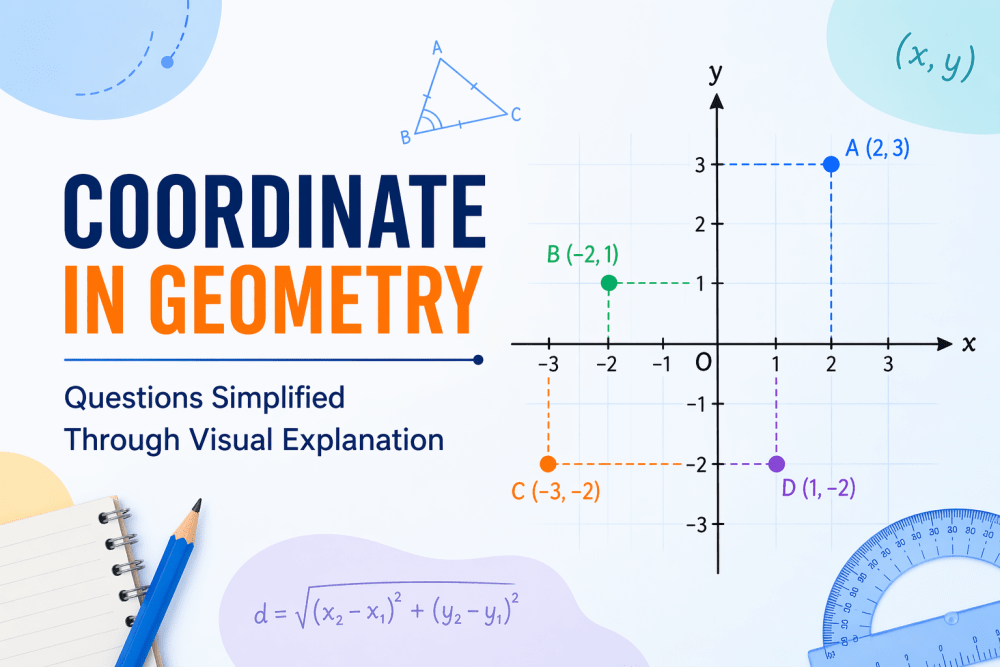
One of the important fields of school maths is coordinate geometry. It provides a good foundation of algebra, trigonometry, and calculus. Year 7 students are taught the process of plotting. By Year 13, they solve complex graphs. The subject is a challenge to many students in the UK, not because maths is a challenging subject, but simply because it is taught abstractly.
At MathsAlpha, we believe that visual learning is one of the most effective ways to understand coordinate geometry. When students can see how points move, how lines are drawn, and how graphs behave, even difficult questions become much easier to understand.
Coordinate geometry connects algebra and geometry through the utilisation of graphs to depict mathematical associations. It demonstrates the visualisation and analysis of equations in a geometrical way.
Key components include:
These skills are introduced early (Year 7-8) and become essential for GCSE, A-Level Maths, and calculus concepts such as differentiation and the quotient rule calculus formula.
Many students find coordinate geometry confusing because:
Without a visual approach, students often guess rather than reason.
Visual problem-solving transforms coordinate geometry from memorisation to understanding.
Instead of rushing calculations, students learn to:
Once points are visible, relationships become obvious.
Visually solving straight-line questions helps students grasp:
For example, students see how increasing the gradient makes a line steeper, no guessing required.
Visual diagrams help students:
This approach reduces errors and builds confidence.
In higher years, coordinate geometry connects directly to calculus topics. Visual graphs help students understand:
This is where concepts like the quotient rule calculus formula become easier to understand, because students can see how one function divided by another behaves on a graph before applying the formula.
Year 7-9 (Foundation Level)
GCSE Level
A-Level Maths
Visual explanations help students at every stage progress smoothly without gaps in understanding.
Students who solve coordinate in geometry visually:
Instead of memorising steps, they develop mathematical intuition.
At MathsAlpha, our online maths tuition focuses on clarity and confidence.
What Makes MathsAlpha Different?
Our tutors adapt lessons to each student’s level, ensuring no one feels lost or rushed.
Coordinate geometry doesn’t have to be confusing. When students learn visually, graphs become meaningful, equations become logical, and advanced topics, including calculus, feel approachable.
If your child is struggling with coordinate geometry or preparing for GCSEs or A-Levels, MathsAlpha’s online tuition provides clear, visual, and exam-focused learning.
Enroll Now and help your child see maths differently and succeed with confidence.
By plotting points and drawing graphs, students can see relationships clearly. Visual methods reduce confusion and improve accuracy in problem-solving.
Many students memorise formulas without understanding graphs. Visual learning helps avoid sign errors and misinterpretation.
Yes, it improves understanding of graphs, curves, and gradients. It also supports advanced topics like the quotient rule calculus formula.
It helps students understand curve behaviour and rates of change visually. This makes calculus rules, including the quotient rule calculus formula, easier to apply.
Live visual online tuition aligned with the UK curriculum works best. Platforms like MathsAlpha support students from Year 7 to Year 13.
.png)
.png)













See our Trustpilot Excellent Reviews