







.png)
Mathematics is a core subject in the education system, and topics like geometric sequences play an important role in building strong analytical skills. However, many students find sequences challenging due to their abstract nature.
Here, we will explore the concept of Geometric Sequences in detail, including their patterns, formulas, and real-life applications. To help you understand the topic more effectively, we will also go through several solved examples step by step.
In addition, GCSE-style exam questions will be included so you can practice and strengthen your problem-solving skills. This guide is designed to build both your confidence and understanding of Geometric Sequences in a simple and clear way.
What is a geometric sequence?
A geometric sequence is a set of terms where each term is found by multiplying previous term by same number.

This constant multiplying factor is called the ‘‘Common ratio’’. Therefore, above sequence has common ratio as 2.
Common Ratio:
Common ratio of a geometric sequence is denoted by r.
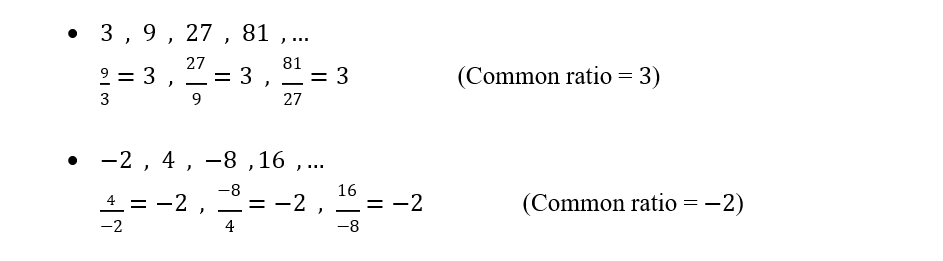
You can find the common ratio by dividing any term by the term before it,
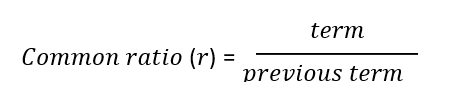
Let 𝑢1 , 𝑢2 , 𝑢3 , 𝑢4 , … , 𝑢𝑛 be terms in a geometric sequence.
Then,

Note: A geometric sequence has a common ratio between consecutive terms, and to get the next term, you have to multiply it by the common ratio.
Next term = Previous term × r

For the geometric sequence 5 , 15 , 45 , …
a) Write the next 2 terms.
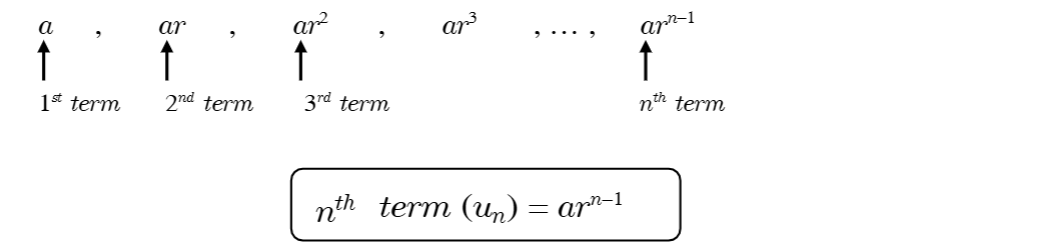
b) Find a formula for the 𝑛𝑡ℎ term.
c) Hence, find the 10𝑡ℎ term of the sequence.
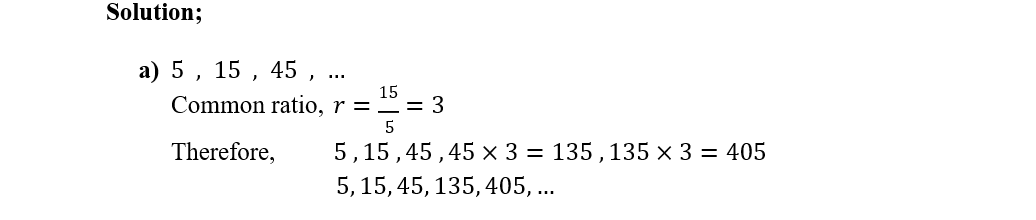
b) 𝑛𝑡ℎ term, (𝑢𝑛) = 𝑎𝑟𝑛−1
𝑎 = 5, 𝑟 = 3
Therefore (𝑢𝑛) = 5 × 3𝑛−1
c) To find 10𝑡ℎ term,
Substitute 𝑛 = 10 into (𝑢𝑛) = 5 × 3𝑛−1 (𝑢10) = 5 × 310−1
= 5 × 39
= 98415
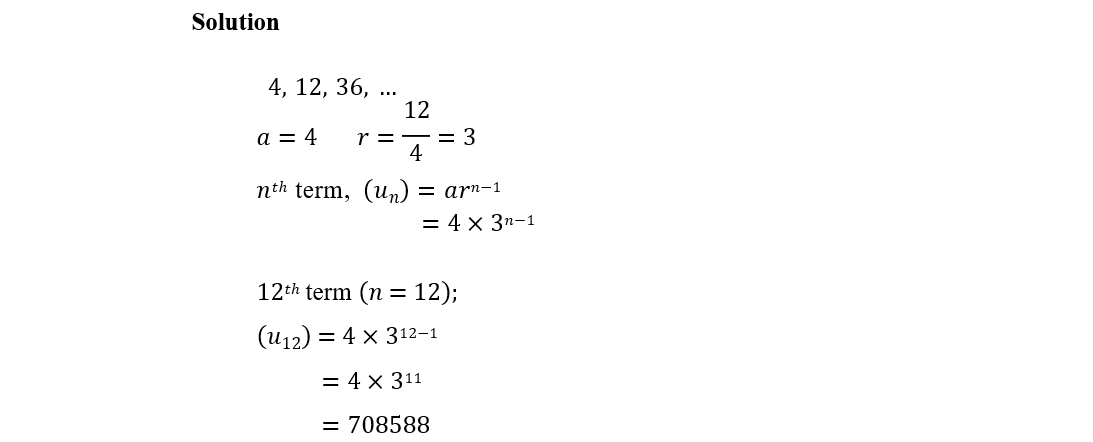
4 , 12 , 36 , … Find the 𝑛𝑡ℎ term of the above geometric sequence. Hence find 12𝑡ℎ term in the sequence.
If 3 , 𝑎 , 9 , … is a geometric sequence, Find 𝑎, (𝑎 > 0)
Solution
3 , 𝑎 , 9 , …
As the sequence is geometric, you can write,

𝑎2 = 27
𝑎 = √27 = √9 × 3 = 3√3
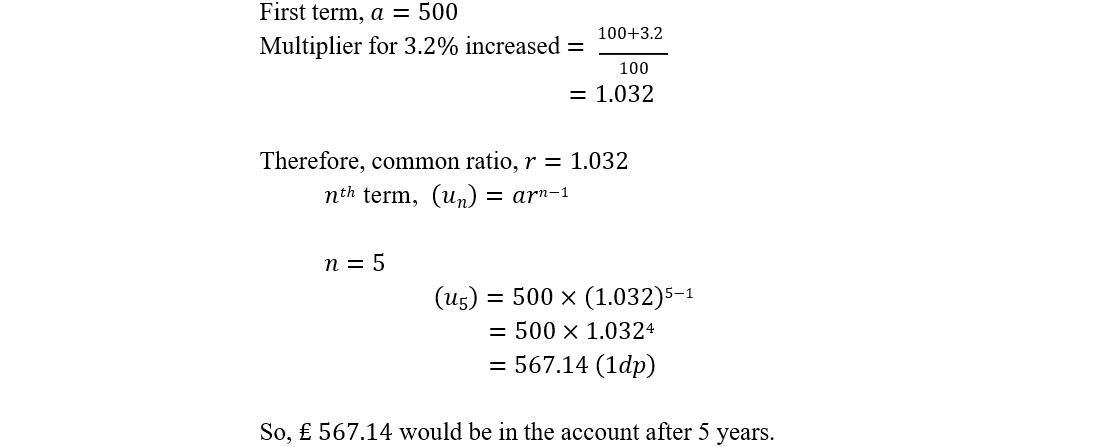
A saving account pays 3.2% annual compound interest. If you deposit ₤ 500 into the account at the start of the first year, how much will be in the account at the start of the 5𝑡ℎ year?
Solution
As each year the balance of the account in increased by the same percentage (3.2% compound interest), end of each year balance in the account is in a geometric sequence.
1. Find the 10𝑡ℎ term of the geometric sequence,
3 , 12 , 48 , 192 , …
2. Find the 12𝑡ℎ term of the geometric sequence,
−2 , 6 , −18 , 54 , …
3. 81 , 27 , 9 , 3 , …
Prove that the above sequence is a geometric sequence.
a) Prove that the above sequence is a geometric sequence.
b) Find the 12𝑡ℎ term in the sequence and give the term in simplest form.
5. A geometric sequence has first term 3 and common ratio 2/3. Find the 𝑛𝑡ℎ term in simplest form.
6. A geometric sequence has first term −5 and common ratio 2. Find the 𝑛𝑡ℎ term of the sequence.
7. A geometric sequence has first term 3 and common ratio 1/3. Which term is equal to 1/39.
8. A bacteria culture starts with 600 bacteria and it doubles every hour.
a) Write a formula for the number of bacteria after 𝑛 hours.
b) How many bacteria are there after 12 hours?
9. A laptop cost ₤ 1200 and loses 20% of its value each year
a) Write a formula for the value after 𝑛 years.
b) Find its value after 5 years.
a) Find the temperature of the cup of tea after 1 minute and after 2 minutes.
b) Write down the temperature after 𝑛 minutes.
c) After how many minutes will the temperature first drop below 50 𝐶𝑜?
11. The 2𝑛𝑑 term of a geometric sequence is 6 and 4𝑡ℎ term is 24. Find the first term and the common ratio of the sequence.
Geometric sequences are an essential concept that builds a strong mathematical foundation for students. With the help of an online maths tutor in UK, learning has become more flexible, accessible, and effective. These classes help simplify complex topics through expert guidance, structured lessons, and interactive tools. Platforms like MathsAlpha play a key role by offering curriculum-focused learning and continuous support.




.png)

.png)
.png)
.png)


.png)

.png)
.png)


.png)

.png)
1.png)




.jpeg)





See our Trustpilot Excellent Reviews