








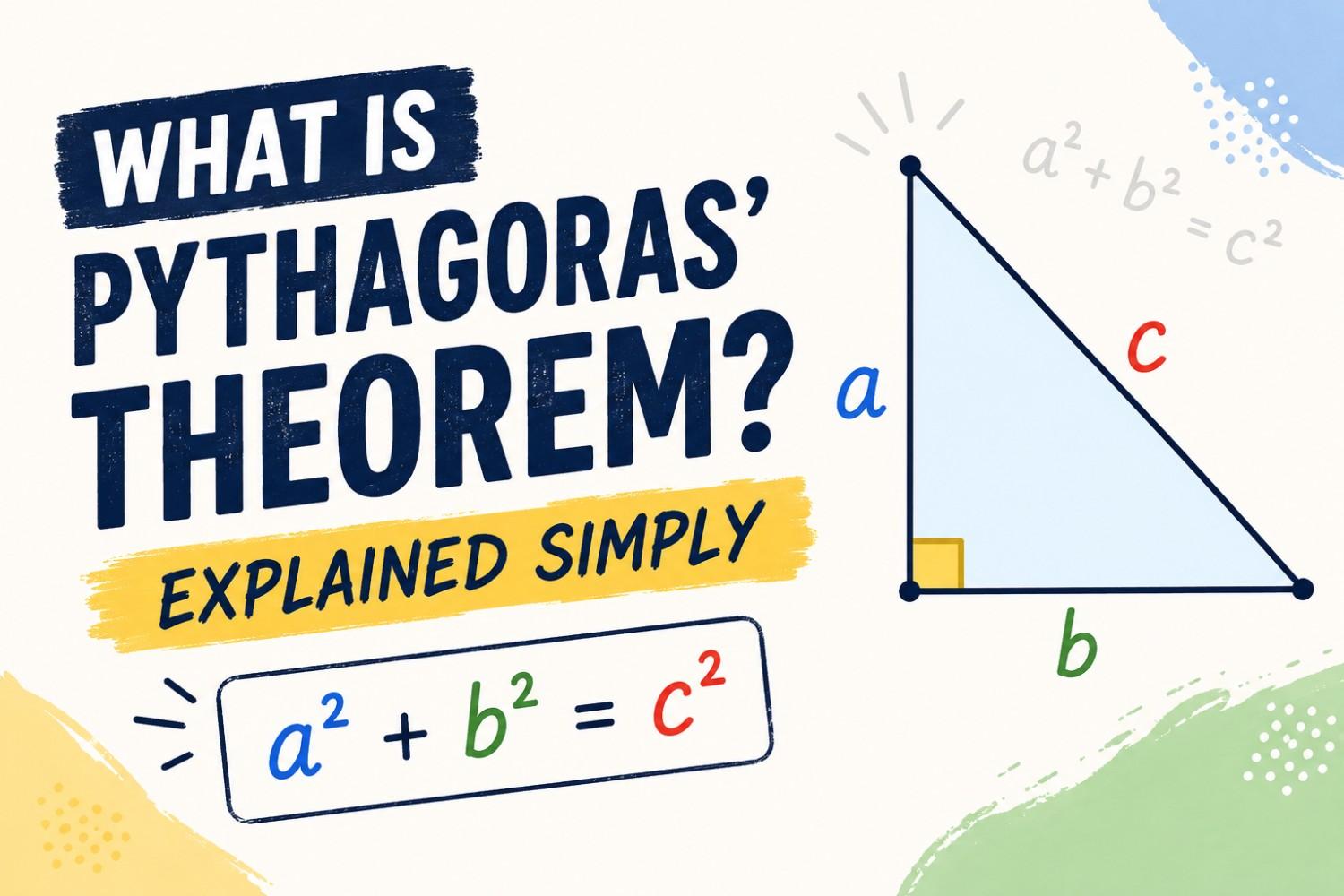
Mathematics is full of useful concepts that help us understand shapes, distances, and measurements. One of the most famous and important concepts in geometry is Pythagoras' Theorem. It is widely used in mathematics, engineering, architecture, construction, navigation, and many real-life situations.
If you have ever wondered how to find the length of a side in a right-angled triangle, Pythagoras' Theorem provides the answer. In this blog, we will explain the theorem in simple language, look at examples, and understand where it is used in everyday life.
Pythagoras was an ancient Greek mathematician who lived around 570 – 495 BCE. He is best known for discovering the relationship between the sides of a right-angled triangle. This relationship became known as Pythagoras' Theorem.
Today, students around the world learn this theorem as a fundamental part of geometry.
Pythagoras' Theorem states:
In a right-angled triangle, the square of the longest side (called the hypotenuse) is equal to the sum of the squares of the other two sides.
The theorem can be represented as:
a² + b² = c²
Where:
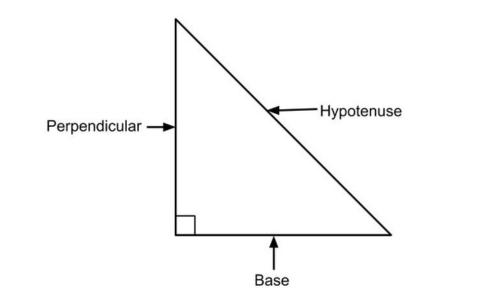
A right-angled triangle has:
The hypotenuse is always opposite the right angle.
Suppose a right triangle has sides:
Using the theorem:
c² = 3² + 4²
c² = 9 + 16
c² = 25
c = √25
c = 5 cm
Therefore, the hypotenuse is 5 cm.
Suppose:
Find the other side.
Using the theorem:
13² = 5² + b²
169 = 25 + b²
b² = 144
b = 12 cm
So, the missing side is 12 cm.
Imagine a ladder is leaning against a wall.
Find the ladder's length.
Using Pythagoras' Theorem:
c² = 6² + 8²
c² = 36 + 64
c² = 100
c = 10 m
Therefore, the ladder is 10 meters long.
At Mathsalpha, we make mathematics easy, interactive, and enjoyable for students. Our expert teachers explain concepts like Pythagoras' Theorem using visual examples, practical activities, and step-by-step problem-solving methods.
Students learn geometry, algebra, trigonometry, arithmetic, and advanced mathematics through structured courses designed to build confidence and improve academic performance.
Whether preparing for school exams, Olympiads, or competitive tests, Mathsalpha helps students develop strong mathematical foundations and critical thinking skills.
Pythagoras' Theorem is one of the most useful and widely used concepts in mathematics. It helps us find unknown side lengths in right-angled triangles and has many practical applications in everyday life.
By understanding the relationship between the sides of a triangle, students can solve a variety of geometry problems with confidence.
Learning and practising Pythagoras' Theorem is an important step toward mastering geometry and developing strong mathematical skills.
Frequently Asked Questions












.png)

.png)
.png)
.png)


.png)
.png)

.png)

.png)




.png)
.png)
1.png)




.jpeg)




See our Trustpilot Excellent Reviews