







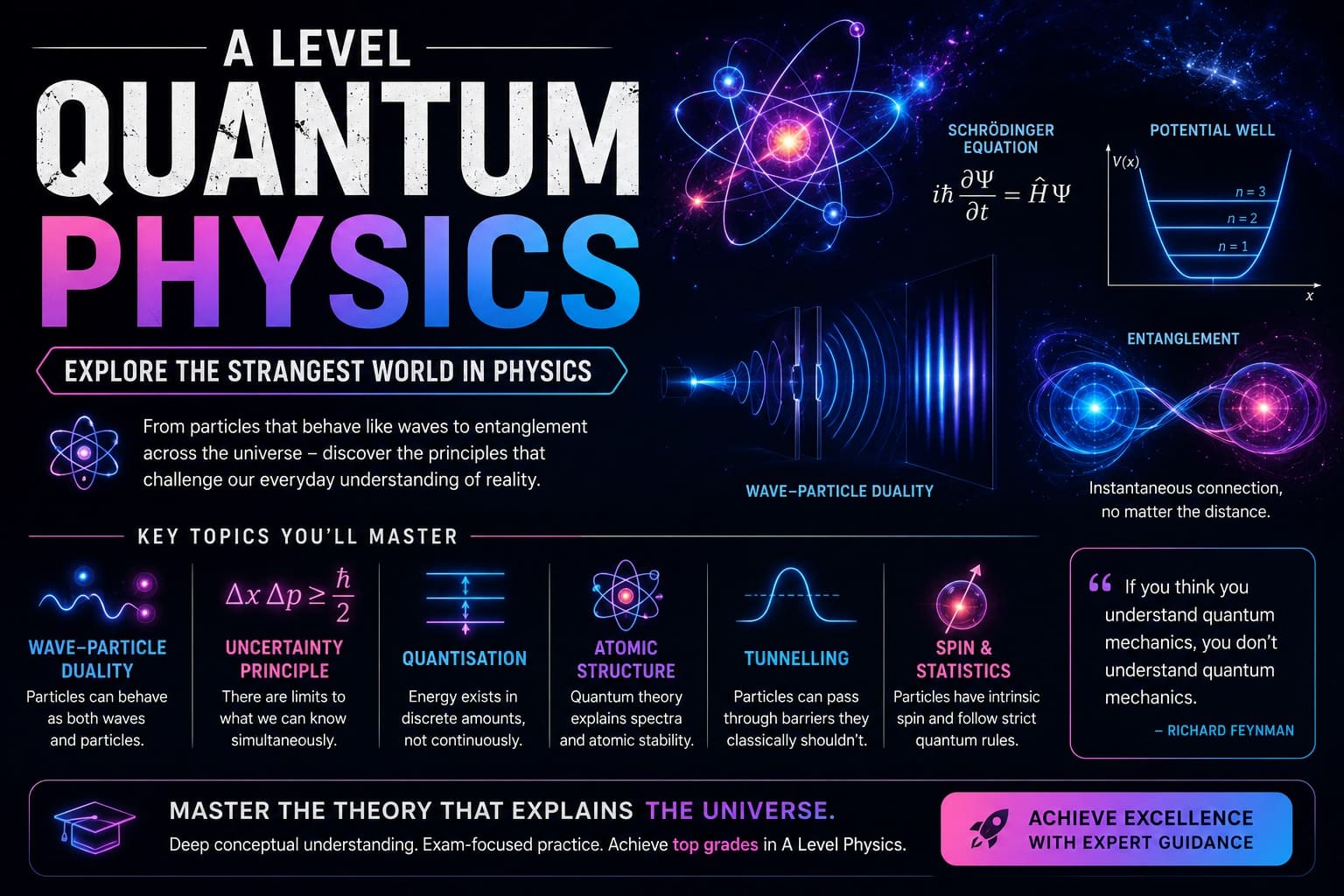
Quantum Physics is one of the most fascinating and mind-bending topics in A-Level Physics. It challenges our everyday understanding of reality by revealing that particles can behave like waves, energy exists in discrete packets, and events at the atomic scale follow entirely different rules from those we experience in everyday life.
Although quantum theory may seem abstract at first, it forms the foundation of modern technology, from lasers and semiconductors to MRI scanners and quantum computing. Mastering this topic not only prepares you for A-Level examinations but also provides insight into one of the greatest scientific revolutions in history.
Classical physics explains the motion of everyday objects remarkably well, but it cannot describe the behaviour of atoms and subatomic particles. Quantum Physics was developed to explain these microscopic phenomena.
In the quantum world:
These discoveries transformed our understanding of the universe and continue to drive scientific innovation today.
One of the central ideas in quantum physics is wave-particle duality.
Light, once thought to be purely a wave, can also behave like a stream of particles called photons. Surprisingly, particles such as electrons can also display wave-like behaviour.
This dual nature has been confirmed through experiments such as electron diffraction and the famous double-slit experiment, demonstrating that matter and light cannot be described using only classical ideas.
Understanding wave-particle duality is essential for answering many A-Level examination questions.
The photoelectric effect provided convincing evidence that light behaves as particles.
When light of sufficient frequency shines onto a metal surface, electrons are emitted almost instantly. Increasing the brightness increases the number of electrons released, while increasing the frequency increases their maximum kinetic energy.
Albert Einstein explained this phenomenon by proposing that light consists of photons, each carrying energy given by:
E = hf
where:
This revolutionary explanation earned Einstein the Nobel Prize in Physics.
Electrons inside atoms can only occupy specific discrete energy levels.
When an electron absorbs energy, it moves to a higher energy level. When it returns to a lower level, it emits a photon whose energy equals the difference between the two energy states.
This explains the unique line spectra produced by different elements and provides strong evidence that atomic energy is quantised.
Werner Heisenberg showed that there is a fundamental limit to how precisely certain pairs of physical quantities can be known simultaneously.
For example, the more accurately we know the position of an electron, the less accurately we can determine its momentum.
This is not due to poor experimental equipment—it is a fundamental property of nature itself.
The Uncertainty Principle is one of the defining ideas of modern quantum mechanics and frequently appears in A-Level examinations.
Quantum Physics is far more than an academic theory. It underpins many technologies used every day, including:
Without quantum theory, much of today's technology simply would not exist.
Students studying A-Level Physics should be confident with:
These concepts form a significant part of most A-Level Physics specifications, including OCR, AQA and Edexcel.
Success in Quantum Physics requires more than memorising equations.
Students should practise:
Developing strong conceptual understanding is the key to achieving top grades.
At Mathsalpha Academy, we make Quantum Physics accessible through expert teaching, interactive lessons, and exam-focused practice. Complex concepts are broken into clear, manageable steps, helping students develop confidence and achieve outstanding A-Level results.
Whether you're learning about photons, wave-particle duality, atomic spectra, or the Uncertainty Principle, our experienced tutors provide the support you need to succeed.
Explore the quantum world, strengthen your understanding, and unlock your full potential in A-Level Physics with Mathsalpha Academy.
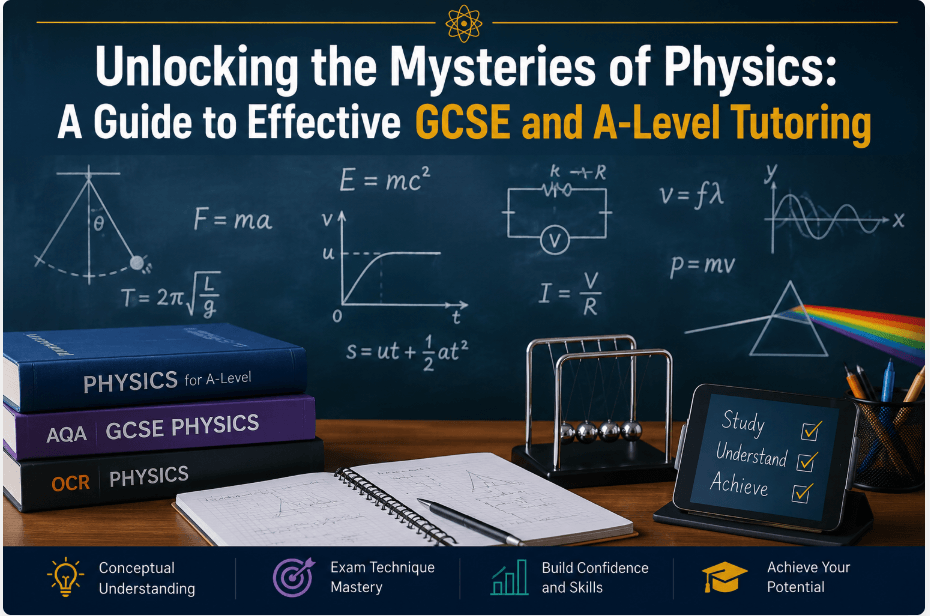
Join our GCSE and A-Level Physics tutoring programmes and discover how expert guidance can help you achieve outstanding examination results.
Book Your Free Assessment
.png)
.png)
.png)
.png)

.png)
.png)
.png)
.png)
.png)
.png)
1.png)


.jpeg)



See our Trustpilot Excellent Reviews