









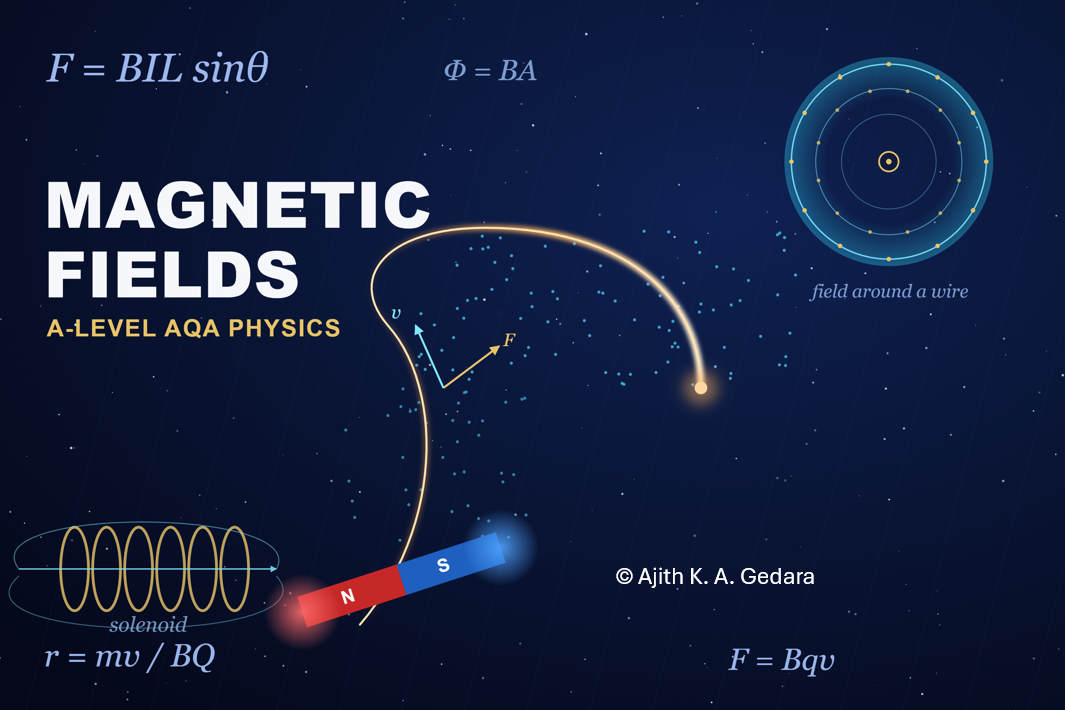
Understanding Magnetic Fields

Magnetic fields are invisible regions around magnets and electric currents where magnetic forces can be detected. Although we cannot see them directly, their effects can be observed when they attract or repel magnetic materials such as iron, nickel, and cobalt.
What is a Magnetic Field?
A magnetic field is a vector field that surrounds a magnet or a current-carrying conductor. It exerts a force on other magnets, magnetic materials, and moving charged particles. The strength of a magnetic field is measured in teslas (T), named after the inventor and electrical engineer Nikola Tesla.
Magnetic Field Lines
Magnetic fields are commonly represented using magnetic field lines. These lines show both the direction and strength of the field. Outside a magnet, field lines emerge from the North Pole and enter the South Pole. The closer the lines are together, the stronger the magnetic field.
How Are Magnetic Fields Produced?
Magnetic fields can be produced in several ways:
- Permanent magnets such as bar magnets and refrigerator magnets.
- Electric currents flowing through wires.
- Moving charged particles.
- The Earth's molten iron core, which generates the Earth's magnetic field.
Magnetic Fields Around Current-Carrying Wires
When an electric current passes through a wire, a circular magnetic field is created around it. The direction of the field can be determined using the right-hand grip rule: if the thumb points in the direction of the current, the curled fingers show the direction of the magnetic field.
Applications of Magnetic Fields
Magnetic fields play a crucial role in many technologies that we use every day:
- Electric motors and generators.
- Magnetic Resonance Imaging (MRI) scanners.
- Loudspeakers and microphones.
- Magnetic storage devices such as hard drives.
- Navigation using compasses and Earth's magnetic field.
Why Study Magnetic Fields?
Understanding magnetic fields is an essential part of Physics at GCSE, IGCSE, and A-Level. Students learn how magnetic fields interact with electric currents, how electromagnets work, and how these principles are applied in modern technology. A strong understanding of magnetic fields provides a foundation for studying electricity, electromagnetism, and engineering.
Conclusion
Magnetic fields are a fundamental aspect of our physical world. From the Earth's protective magnetic field to the operation of electric motors and medical imaging devices, magnetic fields have a significant impact on modern life. By studying magnetic fields, students gain valuable insights into one of the most important areas of Physics.








.png)

.png)
.png)
.png)




.png)
.png)

.png)


.png)





.png)


.png)
1.png)






.jpeg)