








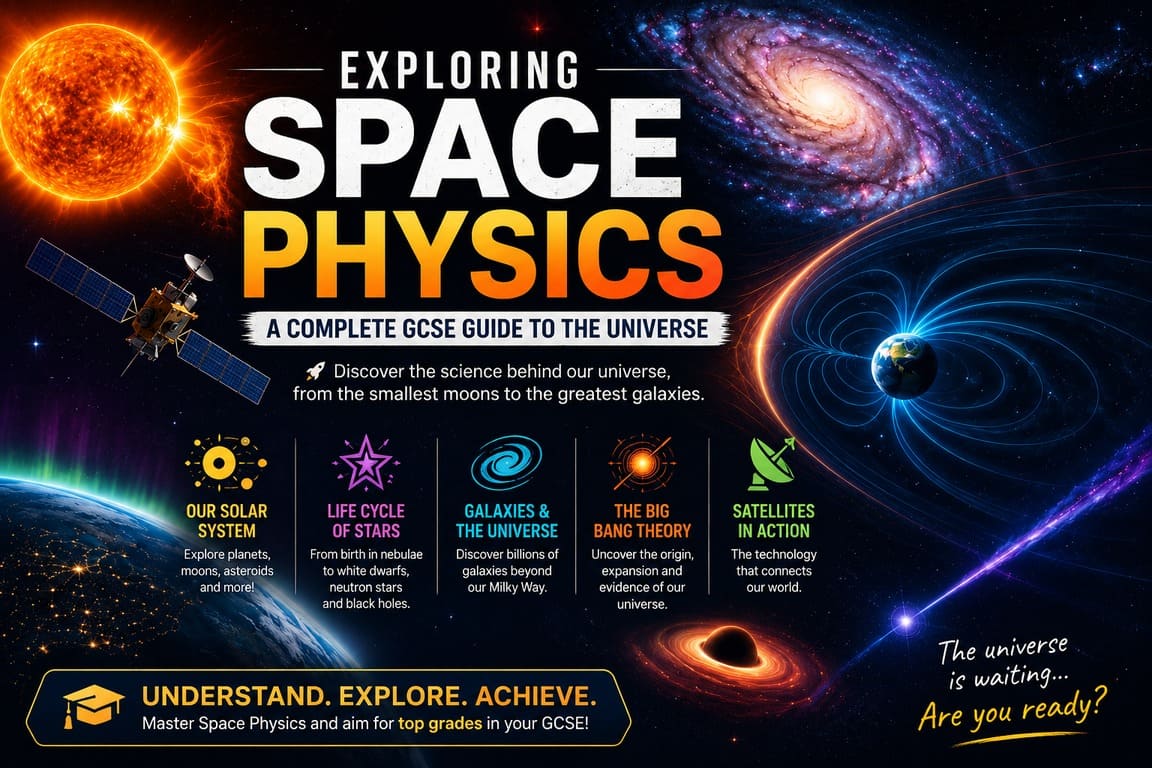
From the birth of stars to the expansion of the universe, Space Physics is one of the most fascinating topics in GCSE Physics. Discover how our Solar System formed, why galaxies move apart, and how modern satellites help us navigate the world every day.
Have you ever wondered how the Universe began? Why do stars shine? What happens when a massive star dies? GCSE Space Physics answers these incredible questions using real scientific evidence collected by astronomers and space missions.
Understanding Space Physics not only helps you succeed in your GCSE examinations but also develops your scientific thinking and appreciation of the amazing universe we live in.
The Solar System consists of the Sun, eight planets, dwarf planets, moons, asteroids and comets, all held together by the force of gravity. The Sun contains more than 99% of the Solar System's total mass, making it the dominant object around which everything else orbits.
The order of the eight planets.Why planets orbit the Sun.Why moons orbit planets.The differences between terrestrial planets, gas giants and dwarf planets.Stars are gigantic balls of hot gas powered by nuclear fusion. They begin life inside enormous clouds of gas and dust called nebulae. The future of a star depends mainly on its mass.
☁️ Nebula⭐ Protostar☀️ Main Sequence Star🔴 Red Giant / Red Supergiant💥 Planetary Nebula or Supernova⚪ White Dwarf / 🌟 Neutron Star / ⚫ Black HoleThis life cycle is one of the most frequently examined topics in GCSE Physics, so make sure you understand each stage.
Our Solar System is part of the Milky Way Galaxy, which contains hundreds of billions of stars. Beyond the Milky Way are billions of other galaxies spread across the observable universe.
Modern telescopes allow astronomers to study distant galaxies and uncover clues about the origin and evolution of the universe.
The most widely accepted explanation for the origin of the universe is the Big Bang Theory. Scientists believe the universe began approximately 13.8 billion years ago from an extremely hot, dense state before expanding rapidly.
These observations strongly support the idea that our universe is still expanding today.
When galaxies move away from Earth, the light they emit shifts towards the red end of the electromagnetic spectrum. This effect is known as red-shift.
Artificial satellites have transformed modern life. They orbit Earth and perform many important tasks.
Students should understand how satellites remain in orbit and why different orbital heights are chosen for different purposes.
Space Physics combines astronomy, physics, engineering and mathematics into one exciting subject. It helps explain everything from black holes and exploding stars to the expansion of the universe itself.
Learning these ideas improves scientific reasoning, develops problem-solving skills and inspires curiosity about the world beyond our own planet.
Join our GCSE and A-Level Physics tutoring programmes and discover how expert guidance can help you achieve outstanding examination results.
Book Your Free Assessment
.png)
.png)
.png)
.png)

.png)
.png)
.png)
.png)

.png)
.png)
1.png)


.jpeg)




See our Trustpilot Excellent Reviews