







.png)
Have you ever wondered how chefs get perfect recipes, how maps show real distances, or how businesses share profits fairly? The answer lies in two simple math ideas - ratios and proportions.
These concepts help us compare quantities and understand relationships between numbers in a clear and practical way. A ratio shows how two or more values relate, while a proportion tells us when two ratios are equal.
From cooking and shopping to banking and travel, they are used everywhere in daily life. Once you understand them, maths becomes easier, faster, and more useful in real-world situations.
.
A ratio is a way to compare two or more quantities of the same kind. It tells us how much one quantity is related to another.
A ratio shows how many times one number contains another.
For example:
This means for every 5 boys, there are 10 girls.
A ratio can be written in three ways:
All three represent the same comparison.
1. First term (Antecedent)
The first number in a ratio.
Example: In 4:7, 4 is the antecedent.
2. Second term (Consequent)
The second number in a ratio.
Example: In 4:7, 7 is the consequent.
1. Part-to-Part Ratio
Compare two different groups.
Example:
2. Part-to-Whole Ratio
Compare one group with the total.
Example:
Simplifying a ratio means reducing it to its lowest form.
Example:
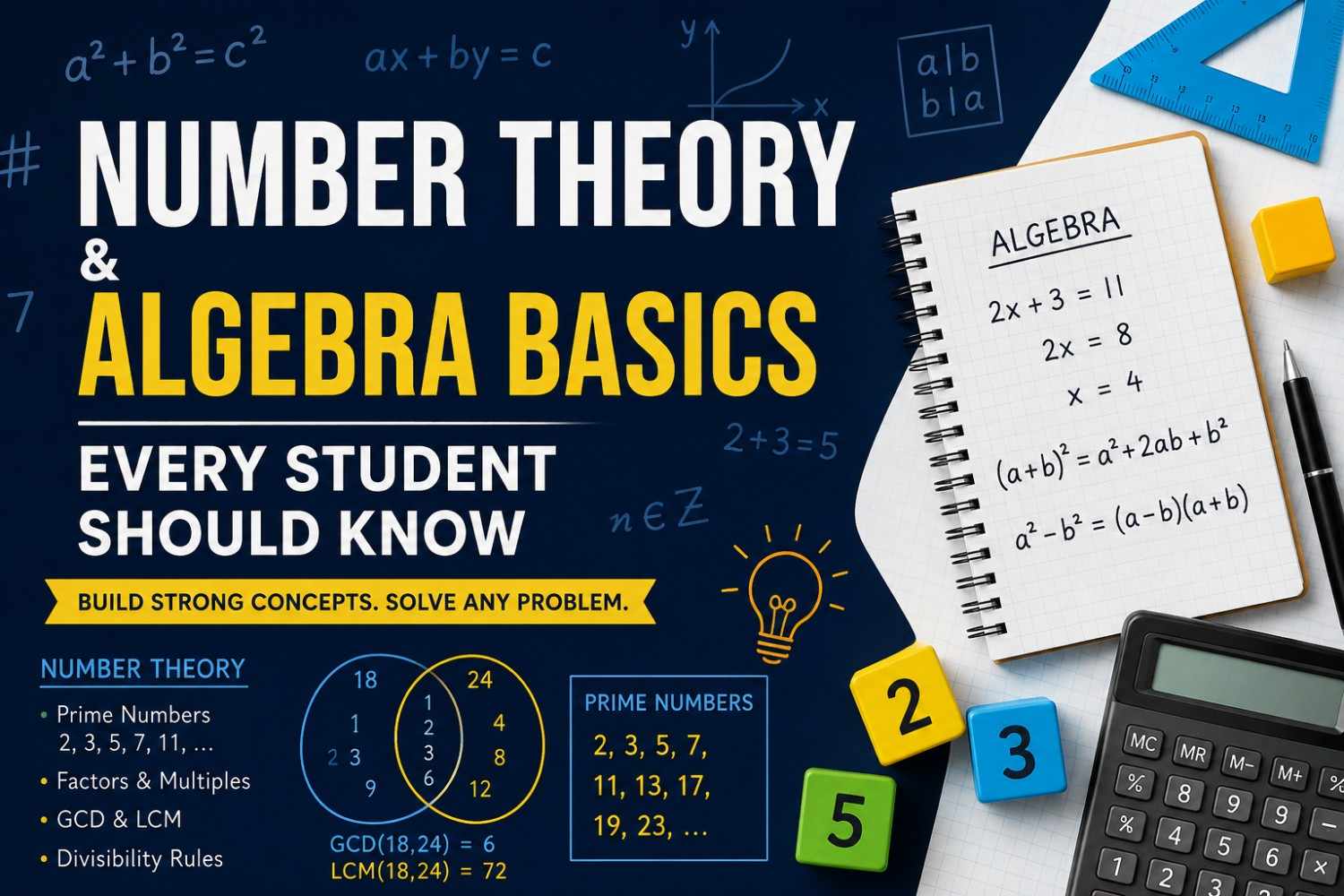
Simplify 18:24
Step 1:
Find HCF = 6
Step 2:
Final answer = 3:4
Equivalent Ratios:
Equivalent ratios represent the same relationship.
Example:
All show the same proportion.
A proportion is when two ratios are equal.
If two ratios represent the same relationship, they are in proportion.
Example:
These are proportions because both sides are equal.
We use cross-multiplication to check whether two ratios are equal.
Example:
Check if 3:4 and 6:8 are in proportion.
Step 1:
Multiply crosswise:
Step 2:
Since both are equal, the ratios are in proportion.
If a, b, c, d are in proportion:
a:b = c:d
Then:
a × d = b × c
This is called the cross multiplication rule.
1. Direct Proportion
When one quantity increases, the other also increases.
Example:
2. Inverse Proportion
When one quantity increases, the other decreases.
Example:
Here it is that a ratio compares quantities, while a proportion shows that two ratios are equal.
|
Feature |
Ratio |
Proportion |
|
Meaning |
Comparison of two or more quantities |
Equality between two ratios |
|
Form |
Written as 3:5 |
Written as 3:5 = 6:10 |
|
Type |
It is an expression |
It is an equation |
|
Purpose |
Used to compare values |
Used to show equal relationships |
|
Example |
2:3 |
2:3 = 4:6 |
Ratios and proportions are used in many real-world situations:
1. Cooking and Recipes
In cooking, ingredients are mixed in fixed amounts to get the right taste.
Example:
Sugar and milk are mixed in a ratio of 1:3.
This means 1 spoon of sugar is used for every 3 spoons of milk.
2. Business and Profit Sharing
In business, partners share profits based on an agreed ratio.
Example:
If profit is shared in the ratio 2:3:5, it means each partner gets a fixed part according to this ratio.
3. Maps and Scale Drawings
Maps use ratios to show real distances in a smaller form.
Example:
1 cm on a map represents 10 km in real life.
4. Banking and Finance
Banks use ratios and proportions to calculate interest and loans.
Example:
It helps in deciding how much interest you will pay or earn.
5. Shopping Discounts
Stores use proportions to calculate discounts on products.
Example:
If an item has a discount, the price is reduced in the same proportion.
Understanding ratios and proportions helps in:
Many students find ratios and proportions confusing at first. The key is simple explanations, step-by-step practice, and proper guidance.
At MathsAlpha online classes, students learn math in an easy and structured way with:
Ratios and proportions are simple but very useful concepts in mathematics. A ratio helps us compare two or more quantities, while a proportion shows when two ratios are equal.
These ideas are used in many real-life situations like cooking, business, banking, maps, and shopping. Understanding them makes everyday calculations easier and improves problem-solving skills.
Learning these basics also builds a strong foundation for higher-level maths. For better understanding and guided learning, students can join expert-led classes like MathsAlpha online classes for step-by-step support and practice.

.png)
.png)
.png)

.png)
.png)

.png)
.png)

.png)
.png)
1.png)

.jpeg)



See our Trustpilot Excellent Reviews