






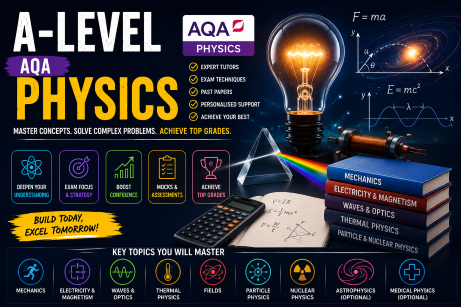
MathsAlpha offers Online AQA A-Level Physics Classes in the UK. A-Level Physics is a significant step beyond GCSE, developing the analytical, mathematical, and problem-solving skills required for university courses such as engineering, physics, medicine, computer science, materials science, and other STEM disciplines.
Many students find the transition from GCSE to A-Level Physics challenging. The mathematical content becomes more demanding, practical skills become increasingly important, and examination questions require deeper scientific understanding. At MathsAlpha, we provide expert AQA A-Level Physics tuition through personalised one-to-one online lessons.
The MathsAlpha AQA A-Level Physics course is designed to help students develop a thorough understanding of Physics while strengthening mathematical reasoning, scientific thinking, and advanced problem-solving skills.
The course fully supports students studying the AQA A-Level Physics (7408) specification and prepares them for success in school assessments, mock examinations, and final A-Level examinations.
Lessons are delivered through one-to-one online tutoring, providing personalised teaching tailored to each student's strengths, learning style, and pace.
Our experienced Physics tutors explain complex topics using clear, step-by-step methods, helping students gain confidence in calculations, practical work, and extended-response questions.
The course places strong emphasis on developing the mathematical skills required for A-Level Physics, including algebra, trigonometry, logarithms, vectors, graphs, and calculus applied to physical situations.
Students receive regular homework, topic tests, exam-style questions, and carefully selected past paper practice to reinforce learning and improve examination performance.
All 12 required practical activities, data analysis, graph interpretation, uncertainty calculations, and experimental techniques are thoroughly covered, ensuring students are fully prepared for both written examinations and practical endorsement requirements.
Throughout the course, students develop effective examination techniques, improve time management, avoid common mistakes, and gain the confidence needed to achieve top A-Level grades.
Your first lesson is FREE.
After that, the fee is £50 for a 2-hour weekly one-to-one lesson.
If a student misses a lesson, a recorded lesson and detailed notes will be provided, although the lesson fee is non-refundable.
If a student decides to discontinue lessons, any unused fees for the remaining part of the month will be refunded.
Payment details will be provided in the enrolment email, and monthly invoices will be issued.
Develop confidence in SI units, uncertainties, significant figures, precision, accuracy, vectors, scalars, graph interpretation, and experimental data analysis.
Study the Standard Model, quarks, leptons, photons, antiparticles, particle interactions, radioactive decay, nuclear equations, and fundamental forces.
Explore progressive and stationary waves, superposition, interference, diffraction, refraction, polarisation, wave intensity, and wave calculations.
Master kinematics, Newton's Laws of Motion, momentum, circular motion, work, energy, power, stress, strain, Young's modulus, and material properties.
Study current, potential difference, resistance, internal resistance, Kirchhoff's Laws, potential dividers, EMF, capacitance, and electrical circuits.
Understand simple harmonic motion, circular motion, ideal gases, kinetic theory, internal energy, and thermodynamic processes.
Develop a thorough understanding of gravitational fields, electric fields, gravitational potential, electric potential, capacitors, and charged particle motion.
Study nuclear instability, radioactive decay, binding energy, nuclear fission, nuclear fusion, and practical applications of nuclear physics.
Explore telescopes, stellar evolution, black-body radiation, the Hertzsprung–Russell diagram, cosmology, red shift, Hubble's Law, and the expanding Universe.
Study X-rays, CT scanning, MRI, ultrasound imaging, PET scanning, radiation therapy, and the medical applications of modern Physics.
Understand rotational dynamics, oscillations, thermodynamics, materials engineering, and engineering applications of Physics.
Investigate the historical development of wave-particle duality, quantum theory, special relativity, and the experiments that transformed modern Physics.
Study semiconductor devices, logic gates, operational amplifiers, digital electronics, and electronic circuit design.
Develop practical investigation skills, uncertainty calculations, graph plotting, data analysis, scientific evaluation, and complete extensive past paper practice to maximise A-Level examination performance.





 For
ForOur courses comprehensively cover the targeted core criteria alignment modules explicitly outlined inside the syllabus plan guide overview detailed above.
Yes. Students receive weekly worksheets, revision tasks, and tutor-marked assignments to support learning outside lessons.


See our Trustpilot Excellent Reviews